

If you’ve spent any time typing questions into ChatGPT, Claude, or Gemini and gotten back something vague, generic, or just plain wrong, you’ve probably wondered if there’s a better way to do this. There is. The way you phrase, structure, and sequence your prompts has a massive effect on the quality of what you get back — and understanding what practices are beneficial for training AI models with prompts is quickly becoming a baseline skill, not a specialized one.
This guide is an honest, practical walkthrough — not a listicle of buzzwords. We’ll cover the core habits that consistently improve output quality, dig into the techniques that separate casual users from people who get reliable results every time, and look at how this applies specifically inside product teams. Along the way, you’ll find a curated set of resources you can start using today at zero cost.
By the end, you’ll understand not just what to do, but why it works — and you’ll have a shortlist of places to practice.
A Quick Clarification: "Training" vs. Prompting

Before diving in, it’s worth clearing up a common mix-up. When people talk about “training AI models with prompts,” they’re usually not talking about literal model training — the process of adjusting a neural network’s internal weights using massive datasets and computing power. That’s fine-tuning, and it’s a different, far more resource-intensive process reserved for engineering teams with access to raw model weights.
What most people actually mean is: how do I get consistently better results from an existing model just by changing how I ask? That’s prompt engineering — and it turns out that well-designed prompts can shape a model’s behavior almost as dramatically as fine-tuning does, without touching a single weight. If you’re still shaky on the fundamentals of phrasing and structure, it’s worth pausing here and working through our Beginner’s Guide to Prompt Editing before going further — the rest of this article builds directly on those basics.
Core Practices That Improve How Models Respond to PromptsBe Specific, Not Just Polite

Vague prompts produce vague outputs. “Write about marketing” gives the model almost nothing to work with, so it defaults to generic, middle-of-the-road content. Specificity — audience, tone, length, format, and purpose — narrows the model’s options and pushes it toward something usable on the first try.
Compare:
- Weak: “Write a marketing email.”
- Strong: “Write a 90-word marketing email for busy freelancers announcing a 20%-off tool discount. Friendly, no jargon, one clear call-to-action at the end.”
The second version isn’t longer because it’s fancier — it’s longer because it removes ambiguity the model would otherwise have to guess at.
Use Examples Only When the Task Is Unusual
Giving the model one or two examples of the input-output pattern you want — known as few-shot prompting — used to be a near-universal recommendation. That’s shifted. In today’s reasoning-capable models, starting with clear, direct instructions and no examples (zero-shot) tends to work better as a default, with examples reserved as a fallback for genuinely ambiguous or idiosyncratic formatting tasks.
Give the Model Room to Reason — But Only When the Task Needs It
Asking a model to “think step by step” before answering can meaningfully improve accuracy on multi-step problems like math, logic, or planning. But it isn’t universally helpful. Research has found that forcing explicit reasoning onto simple tasks that don’t need it can actually hurt accuracy — in some tested cases by more than 36%. The practical rule: save reasoning prompts for genuinely complex tasks, and let simpler ones go straight to an answer.
Set the Frame With System Instructions and Roles
An opening instruction block — often called a system prompt — lets you define the model’s role, tone, and boundaries before the actual task begins. Role prompting (“You are a senior accountant reviewing a tax filing”) shapes vocabulary and framing more than it changes raw reasoning, so it works best when kept functional rather than theatrical. The goal is to encode real constraints — audience, format, what to leave out — not to write a character study.
Break Complex Tasks Into Smaller Steps
Instead of asking for an entire deliverable in one shot — a full go-to-market plan, say — break it into sequential prompts: identify the audience, then the channels, then the timeline. Each link in this chain is simple, testable, and replaceable. When something breaks, you fix that one step instead of untangling one giant, monolithic instruction.
Specify Output Format Explicitly
If you need a table, JSON, a numbered list, or a specific structure, say so directly and upfront. Models generally follow formatting instructions well when they’re stated clearly, which saves an entire round of “can you reformat that” follow-ups.
Evaluate and Iterate Instead of Trusting the First Draft
Treat your first attempt as a starting point, not a finished product. Run it, note what’s missing or off, and refine. For anything used repeatedly — a support-ticket triage prompt, a recurring report generator — it’s worth systematically comparing variations rather than relying on one lucky phrasing.
AI Prompt Engineering — A Deep Dive Into What Changed by 2026
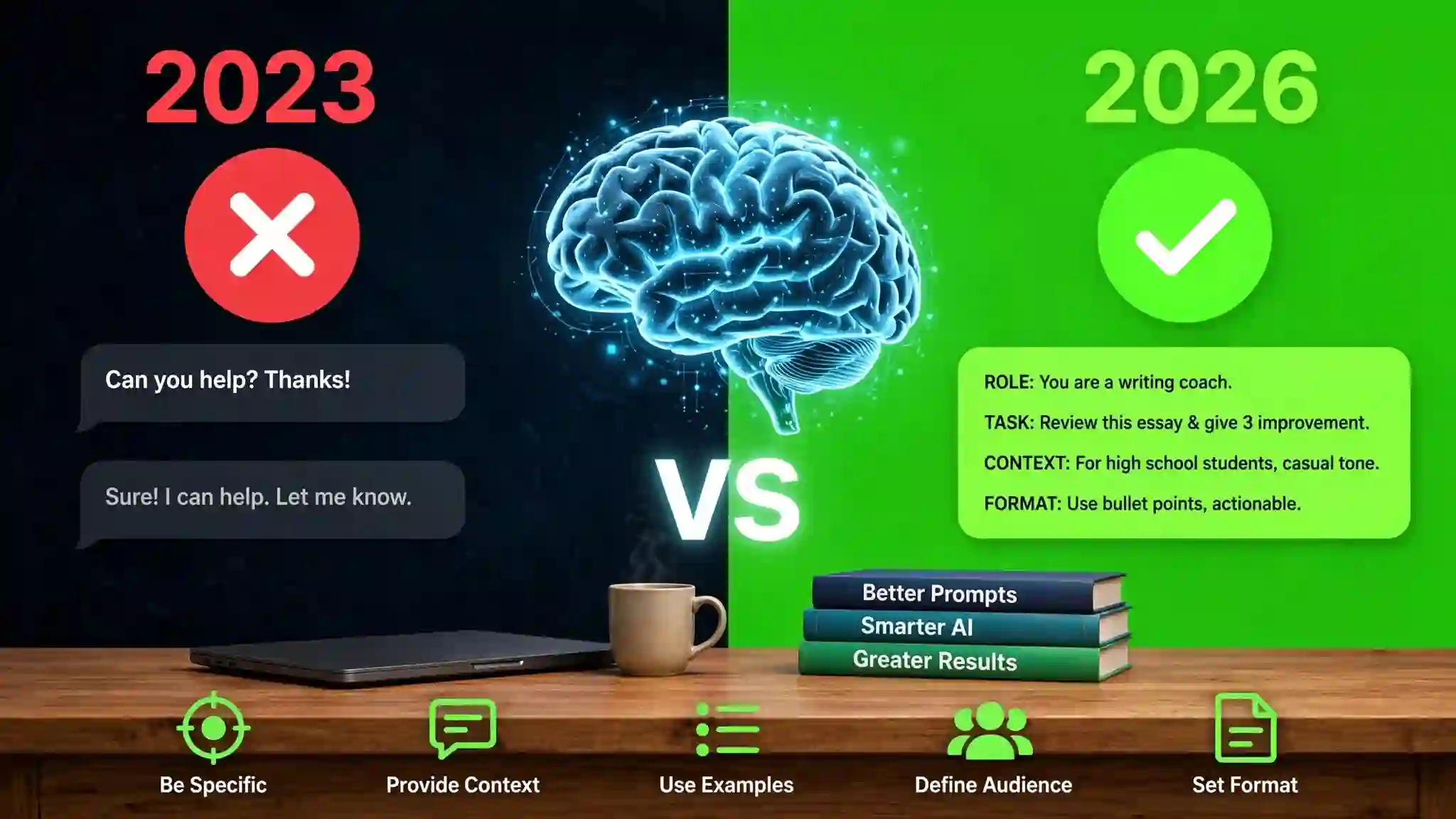
If you learned this skill a couple of years ago, some of what you knew has quietly gone out of date.
Zero-shot first, few-shot as backup. Today’s reasoning-oriented models tend to handle direct, well-specified instructions without needing examples at all. Few-shot prompting hasn’t disappeared, but it’s now the tool you reach for when a zero-shot attempt misses — not the automatic starting point it once was.
Two different skills, not one. There’s a growing split between casual prompting in a chat window and production prompting inside a system that runs the same instruction thousands of times a day, across languages, with no human checking each output. Getting a good answer once in a chat is comparatively easy now, since models tolerate sloppy phrasing. Getting a reliable answer from an automated pipeline running at scale is a different, harder problem — one built around structure, testing, and error-handling around the prompt itself.
Structured prompts inside pipelines compound in value. A one-off prompt typed once has limited upside. A structured prompt embedded in an automated workflow — generating briefs, summarizing reports, routing support tickets — pays off repeatedly because it runs thousands of times rather than once.
The job title faded, the skill didn’t. The standalone “Prompt Engineer” job title peaked around 2023 and has declined by roughly 30% since, while roles that require this skill — AI Engineer, AI Solutions Architect, and AI-literate Product Manager among them — have roughly tripled in the same period. Prompting didn’t vanish as a discipline; it got absorbed into broader roles across knowledge work.
Prompt Engineering for Product Managers
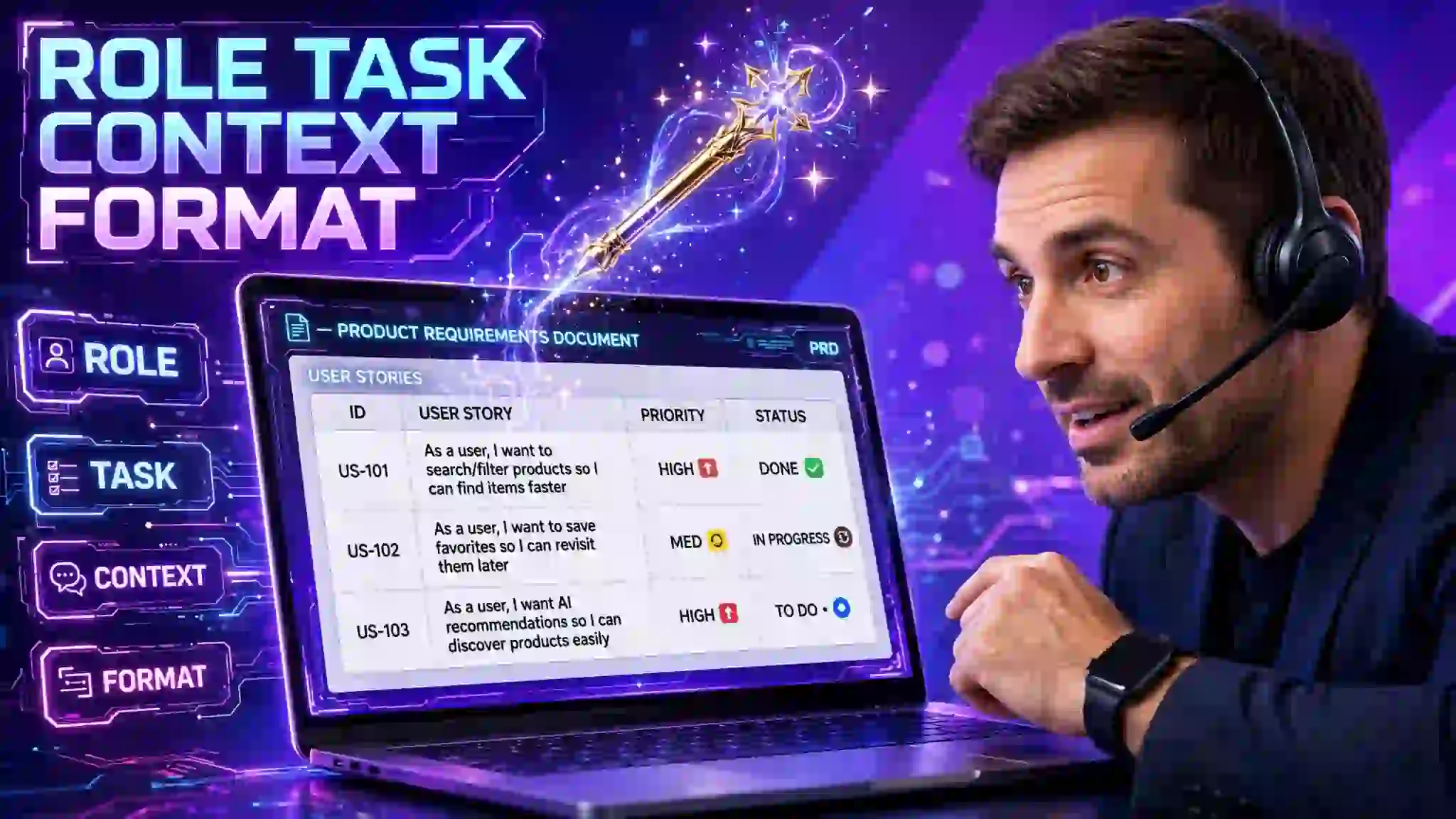
This is where the shift above becomes very concrete. Companies increasingly want product managers who understand model capabilities and limitations well enough to scope AI features realistically — not prompt specialists in the old, narrow sense, but PMs who use AI daily as a working tool.
Where This Skill Pays Off Most for PMs
- Research synthesis — feeding raw interview notes or survey data into a structured prompt to extract themes and pain points, instead of manually re-reading transcripts.
- Spec and PRD drafting — using a repeatable template (context, goal, constraints, format) to produce a first draft that a PM edits rather than writes from scratch.
- Feature scoping — understanding model limits well enough to write realistic requirements for an AI-powered feature instead of over-promising what’s technically feasible.
- Stakeholder communication — drafting roadmap updates and cross-functional briefs in a consistent tone.
A Simple Framework PMs Can Reuse
- Context — what’s the situation, who’s the audience?
- Task — what exactly needs producing?
- Constraints — length, tone, format, what to avoid.
- Iteration — treat the first output as a draft to refine, not a final answer.
This mirrors the core practices covered earlier — specificity, format instructions, and iteration — applied to everyday PM workflows rather than to code or long-form content.
Where to Practice: Free Resources to Learn This in 2026

You don’t need a paid bootcamp to build real skill here. Some of the strongest options cost nothing:
- Anthropic’s Prompt Engineering Tutorial (Anthropic Academy) — a free, hands-on walkthrough covering prompt structure, system prompts, role-prompting, chain-of-thought, and structured outputs, with runnable examples.
- ChatGPT Prompt Engineering for Developers (DeepLearning.AI) — a short, free course covering iterative refinement, summarizing, and transforming text.
- Learn Prompting (learnprompting.org) — a free, text-based reference especially useful for non-technical learners.
- Prompt Design in Vertex AI (Google) — a free guide for anyone working specifically with Google’s models.
- Generative AI for Beginners (Microsoft) — a free, full curriculum covering generative AI fundamentals alongside prompting.
- Prompt Engineering for ChatGPT (Vanderbilt, via Coursera) — free to audit, geared toward non-technical users.
For anyone comparing options among the many free resources available to learn prompt engineering in 2026, a sensible starting combination is the Anthropic tutorial plus the DeepLearning.AI course — a few hours total, entirely free, and enough to put every practice in this article into direct use. If you’d like a slower, example-driven walkthrough before jumping into these, our own Beginner’s Guide to Prompt Editing is a good next click.
Common Mistakes to Avoid
- Over-specifying reasoning steps for simple tasks. Forcing step-by-step reasoning onto a task that doesn’t need it can reduce accuracy rather than improve it.
- Treating persona instructions as theater. A role should encode real constraints — audience, format, scope — not just a fun character voice.
- Writing one giant instruction for a multi-part task. Break it into a chain instead; it’s easier to debug when one link fails.
- Never revisiting a prompt after the first good result. Anything used repeatedly deserves the same iteration and testing you’d apply to any other reusable process.
Frequently Asked Questions
1. What practices are most beneficial for training AI models with prompts?
Specificity, clear format instructions, appropriate use of examples (zero-shot as the default, few-shot when needed), breaking complex tasks into smaller chained steps, and iterating based on actual output rather than assumptions.
2. Is prompt engineering still a real job in 2026?
The standalone job title has become less common, but the underlying skill has spread — it’s now embedded into roles like AI Engineer and AI-literate Product Manager rather than existing as a job on its own.
3. Do I need to pay to get good at this?
No. Free options like Anthropic’s tutorial, DeepLearning.AI’s course, and Learn Prompting’s curriculum cover the core skills thoroughly without a paywall.
4. How is this different for product managers specifically?
PM-focused prompting leans less on raw technique and more on a consistent framework — context, task, constraints, iteration — applied to recurring deliverables like research synthesis, specs, and updates, plus enough model literacy to scope AI features realistically.
5. Should I always ask the model to "think step by step"?
No — save that for genuinely complex, multi-step tasks. On simpler tasks, explicit reasoning instructions can add unnecessary steps and occasionally reduce accuracy.
[…] 2. Become the person who checks the AI. Reviewing, correcting, and signing off on AI output is a growing job in itself. Learning how to give clear instructions also helps. See our guide on [How Effective Prompts Help Train AI Models] […]