

Here’s something nobody tells you before launch day: your first sale teaches you more about payment processing than any comparison chart.
You list a $24 candle. Someone buys it. Later you notice the payout is a little smaller than you expected. Not by much, roughly a dollar. But that dollar repeats on every order you’ll ever take, which is why choosing among the best payment processing companies for new e-commerce stores in 2026 is a money decision, not a setup checkbox.
This guide is built for people who don’t have a finance team. You’ll see what the major processors really charge, where the extra costs hide, which option is the cheapest payment gateway for different store sizes, and whether a white label payment gateway is something you’d ever need. You’ll also get a free calculator to test your own numbers. Some of the figures come straight from published pricing pages. Others are my own math on top of those pages, and I’ll flag which is which.
1. Quick answer: which processor should a new store pick in 2026?
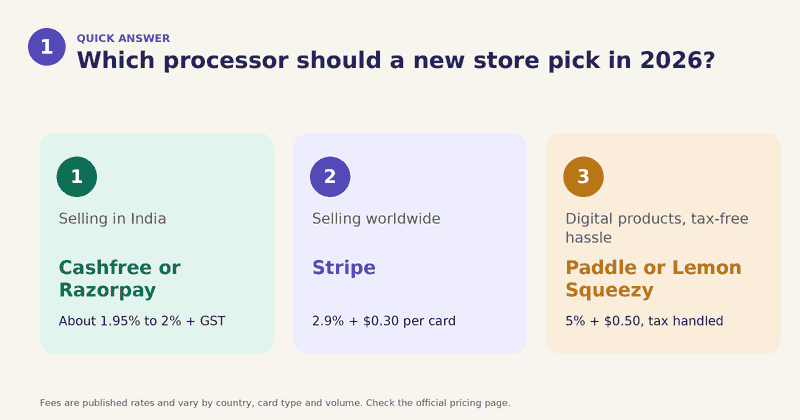
If you sell on Shopify, use Shopify Payments. If you run a custom, WooCommerce or headless store, start with Stripe. Add PayPal as a second checkout button, not as your main engine. Look at Helcim once your monthly card volume is meaningful. Treat Authorize.net as a special-case tool. If you sell from India, Cashfree and Razorpay are the two names to compare first.
| Processor | Best for | Typical online card rate | Watch out for |
|---|---|---|---|
| Shopify Payments | Stores on Shopify | About 2.4%–2.9% + 30¢ depending on plan | Using any other gateway on Shopify adds a platform fee |
| Stripe | Custom sites, subscriptions, global sales | 2.9% + 30¢ (US) | Add-ons and international stacking |
| Square | Stores that also sell in person | 3.3% + 30¢ on the free plan | Online rate is higher than its in-person rate |
| PayPal | Customers who want to pay with PayPal | 3.49% + 49¢ for PayPal Checkout | High fixed fee and $20 chargeback fee |
| Helcim | Growing stores that want lower costs | Interchange-plus, roughly 0.4%–0.5% + 20–25¢ markup | Pricing varies by card type |
| Authorize.net | Merchants who need a traditional gateway | 2.9% + 30¢ plus $25/month | Monthly fee even at low volume |
Shopify’s published rates differ slightly between sources (some list 2.6%/2.4% for higher plans, others 2.7%/2.5%), so check your plan page.
2. How much do payment gateways charge per transaction?

Direct answer: Most payment gateways charge roughly 2.4% to 3.5% of the sale plus a fixed 30 to 49 cents per online card transaction in the US in 2026. Stripe and paid Square tiers sit at 2.9% + 30¢, PayPal Checkout at 3.49% + 49¢, and interchange-plus providers such as Helcim start lower but vary by card.
That’s the headline. The part that matters is how the formula behaves on your actual orders.
The two-part formula
Every fee is a percentage plus a flat amount. The percentage scales with order size. The flat amount doesn’t, and it quietly punishes small baskets.
The fixed-fee tax on small orders
Here’s my own math on two published rates (Stripe’s 2.9% + 30¢ and PayPal Checkout’s 3.49% + 49¢):
| Order size | Stripe fee | Stripe effective rate | PayPal Checkout fee | PayPal effective rate |
|---|---|---|---|---|
| $20 | $0.88 | 4.4% | $1.19 | 5.9% |
| $50 | $1.75 | 3.5% | $2.24 | 4.5% |
| $100 | $3.20 | 3.2% | $3.98 | 4.0% |
| $200 | $6.10 | 3.1% | $7.47 | 3.7% |
See the pattern? A store that averages $20 orders pays a very different real rate than one averaging $200, even on the same processor. One 2026 fee calculator makes the same point more bluntly: a $5 charge on Stripe costs about 9% once the fixed fee is included.
What most guides miss: your average order value is as important as the advertised rate. Before comparing providers, divide your expected monthly processing fees by monthly sales. That effective rate is the only number that counts. [Product Advertisement]
3. Compare payment gateway charges: the big six for new stores

Here’s how to compare payment gateway charges without drowning in tabs. Each of these has a clear lane.
Stripe: the default for custom stores
Stripe’s standard US price is 2.9% + 30¢ per successful online card charge, with no setup or monthly fee for standard payments. That’s why many guides treat it as the benchmark every other processor gets compared against.
The real value is flexibility: strong developer tools, subscriptions, and global reach. The catch is that Stripe is more of a stack than a single product. Add-ons such as tax calculation (reported at 0.5% per transaction), billing tools and fraud screening can stack onto the base fee.
Here’s a detail worth knowing: at higher volume, Stripe will talk interchange-plus pricing. One payments consultancy that negotiates for clients reports a deal at 0.22% + 15¢ over interchange for a complex merchant, and a best case of 0.09% + 8¢ for a business processing more than $4 million a month. That’s a consultancy’s own client data, not a public rate card, so treat it as a ceiling on what negotiation can do, not a promise. A 2026 pricing guide suggests raising the conversation once you cross roughly $80K a month in card volume.
Shopify Payments: the simplest option if you’re on Shopify
If you’re on Shopify, this is usually the easy answer because it adds no extra platform fee. Online card rates drop as you move up plans, from about 2.9% + 30¢ on Basic to roughly 2.4%–2.5% + 30¢ on Advanced.
Now the trap. If you use another gateway instead, Shopify adds its own transaction fee on top: 2% on Basic, 1% on the middle plan and 0.6% on Advanced, according to several 2026 breakdowns. So Stripe used directly on a Basic Shopify plan works out to 4.9% + 30¢.
My math on that: on a $20 order, you’d pay $1.28, which is 6.4% of the sale. Same store, same customer, nearly double the cost of simply using Shopify Payments. That’s the single most avoidable fee in e-commerce.
Square: strong in person, pricier online on the free plan
Square is built around point-of-sale. Its free plan charges 3.3% + 30¢ online, while Plus and Premium plans bring online cards down to 2.9% + 30¢. Founders often see Square’s low in-person rate and assume it applies online. It doesn’t. Square makes sense if you also sell at markets or a shop. For an online-only store, it’s rarely the cheapest.
One genuine plus: a Shopify-focused comparison from a chargeback-alert company lists Square’s chargeback fee at $0, versus $20 on PayPal.
PayPal: take it, but don’t build around it
PayPal Checkout’s US rate is 3.49% + 49¢ for PayPal and Venmo payments, and card payments run roughly 2.89%–2.99% + 29–49¢ depending on setup. Pay Later transactions have been listed at 4.99% + 49¢. Cross-border sales add another 1.5%, and one 2026 comparison flags a $20 chargeback fee.
So why bother? Because many shoppers trust the PayPal button, and offering it can lift conversion. Think of it as an extra door into your store, not the main entrance. If you sell very low-priced digital goods, PayPal has a micropayments plan that reduces the fixed fee.
Helcim: the low-cost challenger
Helcim uses interchange-plus pricing, meaning you pay the card network’s wholesale cost plus a small markup. One 2026 guide lists online markups of roughly 0.40%–0.45% + 20¢, while another lists 0.5% + 25¢. Volume discounts reportedly begin around $50,000 a month, and Helcim has no monthly fee or long-term contract.
The tradeoff is predictability. Because the wholesale cost depends on the card (a premium rewards card costs more than a basic debit card), your effective rate moves around. It also adds about 1% on international sales, which Helcim says is bank-imposed rather than a markup. Helcim also offers a feature that lets you pass processing costs to customers through compliant surcharging. Check your state’s rules before using it.
Authorize.net: only if you know why you want it
Authorize.net typically costs $25 a month plus 2.9% + 30¢. Compared with Stripe’s 2.9% + 30¢ and no monthly fee, that’s the same percentage with a monthly charge on top. Some merchants use it because they want to keep their own merchant account or work with a specific processor. For a brand-new store without that need, it’s usually harder to justify.
4. Payment gateway cost: the fees nobody puts on the pricing page

The advertised rate is the first layer. The real payment gateway cost includes everything below.
Refunds don’t give your fee back
One 2026 pricing review notes that Stripe does not return the original processing fee when you refund a payment. Refund a $100 order and you’ve lost the $3.20 you paid to process it, on top of the sale. If your product category has high return rates, build this into your margins.
Chargebacks cost more than the order
Stripe lists a $15 dispute fee and PayPal a $20 fee in the sources I reviewed. Here’s the bit most people miss: losing a $50 dispute can cost you the $50, the product, the shipping, the original processing fee and the dispute fee. One order can become a $90+ hit. Keep your billing descriptor clear (the name customers see on their statement), since confusing descriptors are a common trigger for disputes.
The international stack
Fees can stack. Stripe’s published structure adds a 1.5% international card fee and a 1% currency conversion fee on top of the base rate. My math: a $100 sale to an international card that also needs currency conversion becomes 2.9% + 1.5% + 1% = 5.4% + 30¢, or $5.70. If you plan to sell abroad, model this before you pick a plan.
Add-ons
Tax calculation at 0.5% means a $100 sale costs $3.70 instead of $3.20 (again, my arithmetic). Fraud screening, invoicing and subscription billing tools can add their own charges. None of these are unreasonable, but you should decide which ones you actually need. [Product Advertisement]
5. Cheapest payment gateway: it depends on three numbers

There’s no single cheapest payment gateway. There’s only the cheapest one for your average order value, monthly volume and platform. Use the calculator below to test your own numbers. It covers Indian providers (Cashfree, Razorpay, PhonePe) and global ones (Stripe, Square, PayPal, Paddle, Lemon Squeezy, Coinbase Commerce). Providers with custom pricing, like PayU, CCAvenue, Adyen and Mollie, are listed separately because they need a written quote.
Which payment gateway is cheapest for your store?
Enter your own numbers. The ranking updates as you type.
Rates are the listed headline figures and will change. Indian fees include 18% GST on the fee. International and currency-conversion add-ons are estimates. Always confirm on the provider's pricing page before you sign up.
Once you’ve tried it, here’s the practical way to think about each size of store.
Under about $10K a month: avoid stacking, keep it simple
At this stage, headline rates cluster around 2.9% + 30¢, so the real savings come from avoiding extras. On Shopify, use Shopify Payments. Elsewhere, Stripe’s flat rate is easy to predict, and its fixed fee is lower than PayPal’s, which helps on small orders.
About $10K to $80K a month: ask whether interchange-plus fits
Here interchange-plus providers like Helcim start to look interesting, particularly if your average order is larger and your customers use plain debit and standard credit cards. One 2026 guide suggests interchange-plus typically saves 0.5%–1% per transaction compared with flat-rate pricing, though savings vary heavily by card mix. On $50,000 of monthly sales, even 0.5% is $250 a month. Ask for a written quote, not a headline.
Above that: negotiate
At higher volume, flat rates are a starting point, not a final price. Ask your processor for a custom quote and compare it against at least one alternative.
6. The 2026 card settlement: what it means for small stores

Here’s something you probably haven’t read about in a payment gateway comparison. After nearly 20 years of litigation, Visa and Mastercard agreed in late 2025 to a revised settlement with US merchants. Reporting says it would end their long-standing honor-all-cards rule for certain card categories and lower the average effective credit interchange rate by 10 basis points for five years. A court granted preliminary approval in June 2026. I couldn’t confirm final approval, so check the latest status before acting on any of this.
Here’s what could matter for you:
- Choice of card categories. Merchants could choose whether to accept standard consumer, premium consumer or commercial credit cards.
- Surcharging. Merchants may be able to surcharge eligible credit cards, generally capped at the lesser of 3% or their actual cost of acceptance. Debit cards are treated differently.
- Collective bargaining. The settlement is described as enabling merchant buying groups to negotiate interchange collectively.
My read, which is an inference rather than a reported fact: these tools probably help stores with interchange-plus pricing more than stores on flat-rate pricing, because flat rates blend all card types into one number and hide the cost differences these rules are designed to expose. And don’t rush to surcharge. Analysts quoted in industry coverage expect few merchants to use the option, and a surcharge can cost you conversions with price-sensitive shoppers. Treat it as a future lever, not a launch-day plan.
7. White label payment gateway cost: do you actually need one?

Short answer: almost certainly not as a new e-commerce store. A white label payment gateway is for companies that want to offer a payment service under their own brand, such as software platforms or payment resellers. If you just want to accept payments in your own shop, Stripe, Shopify Payments or similar will do the job.
Still, the question comes up often, so here’s what the cost looks like. There’s rarely one headline price. Providers describe a mix of setup fees, customization fees, maintenance, monthly or annual fees, and per-transaction fees, and the volume you expect shapes the quote.
For ballpark numbers, one startup cost projection suggests a white-label setup fee of around $75,000, a payment-facilitator model ranging from $100,000 to $300,000, and building a proprietary gateway from scratch starting around $500,000 and going well beyond. Another vendor guide puts building your own at $500K–$2M or more. These come from consultancy and vendor content, not audited price lists, so use them for scale, not budgeting. The point is the gap: running your own gateway is a different business, with compliance, security and risk costs that dwarf the fee savings for a young store.
There’s a middle path worth knowing: a payment facilitator (PayFac) lets you accept cards under its master merchant account without your own, which is how most small processors work. It’s fast to start, but one consultancy notes you’ll have less room to negotiate rates unless your volume is high.
A five-minute checklist before you sign up
- Estimate your average order value and monthly sales.
- Calculate your effective rate, not just the headline (the calculator above does this for you).
- Check whether your platform adds a fee for outside gateways.
- Look up the refund, chargeback and international fees.
- Offer at least two payment options, but don’t make the costliest one your default.
- Set a calendar reminder to re-quote your pricing every six months.
Frequently asked questions
How much do payment gateways charge per transaction?
Most charge about 2.4%–3.5% plus 30–49¢ per online card payment in the US. Stripe is 2.9% + 30¢, PayPal Checkout 3.49% + 49¢, and Shopify Payments roughly 2.4%–2.9% + 30¢ depending on plan.
What is the cheapest payment gateway for a new online store?
For most new stores the cheapest option is the one that avoids stacked fees: Shopify Payments on Shopify, or Stripe elsewhere. Interchange-plus providers like Helcim can be cheaper as volume grows. In India, compare Cashfree and Razorpay using your own order value in the calculator above.
Is Stripe or PayPal cheaper?
On standard card payments, Stripe's 2.9% + 30¢ is cheaper than PayPal Checkout's 3.49% + 49¢. On a $100 sale, that's about $3.20 versus $3.98.
What is a white label payment gateway and what does it cost?
It's a payment platform you brand as your own. Costs usually combine setup, maintenance and per-transaction fees, and some projections put setup alone around $75,000. Most new stores don't need one.
Can I pass processing fees to customers?
Sometimes. Surcharging rules differ by card type, state and processor, and the new card settlement adds limits such as a 3% cap. Check the rules and your processor's policy first.
Sources :-
- Stripe pricing breakdown 2026, Flexprice: https://flexprice.io/blog/stripe-pricing-breakdown-2026
- Stripe Pricing 2026, ERP Research: https://erpresearch.com/erp-add-ons/processing/stripe/pricing
- Stripe pricing and calculator, Toolradar: https://toolradar.com/tools/stripe/pricing
- Stripe fee calculator, Size.ly: https://www.size.ly/tools/stripe-fee-calculator
- Stripe pricing and complaints, Costbench: https://www.costbench.com/software/payment-processing/stripe/
- Stripe review and negotiated rates, Merchant Cost Consulting: https://merchantcostconsulting.com/?p=6224
- Credit card processing for small business 2026 rates, Ueni: https://ueni.com/blog/how-to-accept-card-payments-small-business/
- PayPal fees 2026, NerdWallet: https://www.nerdwallet.com/article/small-business/paypal-fees
- PayPal fees, Shopify: https://www.shopify.com/blog/paypal-fees
- Best payment gateway for small business 2026, Aspire: https://aspireapp.com/en-us/blog/best-payment-gateway-for-small-business
- Payment gateway comparison, elogic: https://elogic.co/blog/payment-gateway-comparison-a-comprehensive-guide/
- Best Stripe alternatives 2026, TechRepublic: https://www.techrepublic.com/de/article/stripe-alternatives/
- Best payment gateways, NerdWallet: https://www.nerdwallet.com/business/software/best/payment-gateways
- PayPal alternatives, Fit Small Business: https://fitsmallbusiness.com/paypal-alternatives
- Best Shopify payment gateways 2026, Chargeback.io: https://www.chargeback.io/ru/blog/best-shopify-payment-gateways
- Shopify payment fees, TrueProfit: https://trueprofit.io/blog/shopify-payment-fees
- How much does Shopify cost, First Pier: https://www.firstpier.com/resources/how-much-does-shopify-cost-e3c58
- Visa and Mastercard reach legal pact with merchants, Payments Dive: https://www.paymentsdive.com/news/visa-mastercard-reach-legal-pact-with-merchants/805137/
- Rewards cards after the Visa-Mastercard merchant settlement, LEK: https://www.lek.com/insights/financial-services/finding-new-balance-rewards-cards-after-visa-mastercard-merchant
- Court grants preliminary approval to interchange settlement, America’s Credit Unions: https://www.americascreditunions.org/node/27531
- Interchange settlement terms, MyPaymentSavvy: https://mypaymentsavvy.com/?p=7812
- White label payment gateway cost, Decta: https://www.decta.com/company/media/white-label-payment-gateway-cost
- Internet payment gateway startup costs, Startup Financial Projection: https://startupfinancialprojection.com/blogs/capex/internet-payment-gateway
- White label payment processing, Payneteasy: https://payneteasy.com/llms/glossary/white-label-payment-processing.md
- Should your business use a PayFac, Merchant Cost Consulting: https://merchantcostconsulting.com/?p=7266