
You have probably seen ten product advertisements before breakfast. A cereal box, a phone notification, a newspaper flyer, a sponsored post. Most of them vanished from your memory in seconds. A few made you reach for your wallet.
What separates the two groups? It is rarely the budget. It is usually clarity (what is being sold), credibility (why you should believe it), and channel (where you meet the message).
In this guide you will learn what a product advertisement is, how it differs from institutional advertising, why advertisements with testimonials work, and where the ethics of testimonial advertising stand. You will also see how newspaper advertising and advertising in magazines still earn their place in a digital world. Along the way, I have included a few findings from real research that surprise most marketers.
1. What Is a Product Advertisement?
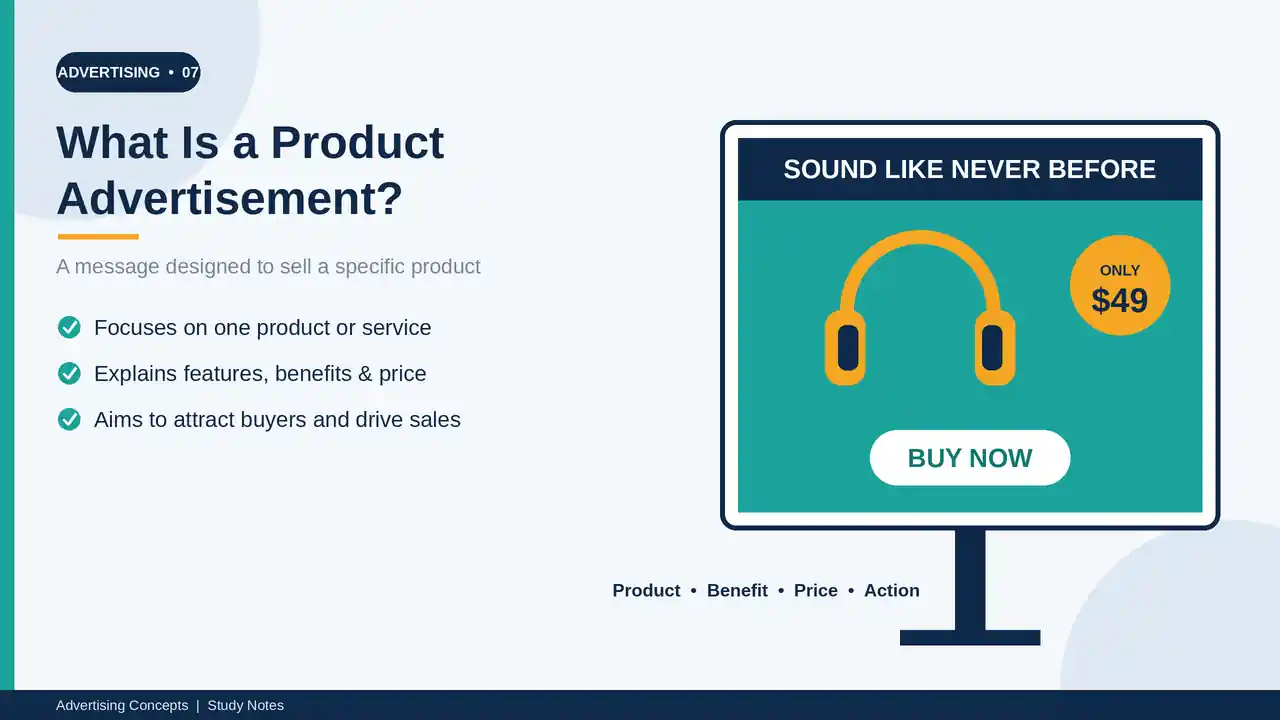
A product advertisement is a paid message that promotes a specific product, service, or product line, with the goal of getting people to buy, try, or ask for more information. Product advertising focuses on one particular item and highlights its features, benefits, and unique selling points. usermaven
That is the short, snippet-friendly answer. In practice, a product advertisement answers three questions in a few seconds:
- What is this?
- Why should I want it?
- What should I do next?
The three classic types of product advertisement
Marketing textbooks usually sort product advertisements by where the product sits in its life:
- Pioneering ads introduce something new and explain what it does. Think of the first ads for electric cars or meal-kit boxes. The job is education.
- Competitive ads argue that your product beats the alternatives, either directly or by implication.
- Reminder ads keep a familiar product in mind. A soft-drink billboard is a good example. Nobody needs to be told what cola is.
If you sell to teachers, a pioneering ad might explain what a digital lesson bundle is. A reminder ad might simply say “new term, new resources.” That kind of thinking suits a store like the [Online Marketplace for Teachers], where buyers are busy and decisions are fast.
2. What Is the Difference Between Product Advertising and Institutional Advertising?
This is the question students and small business owners search for most, so here is the direct answer.
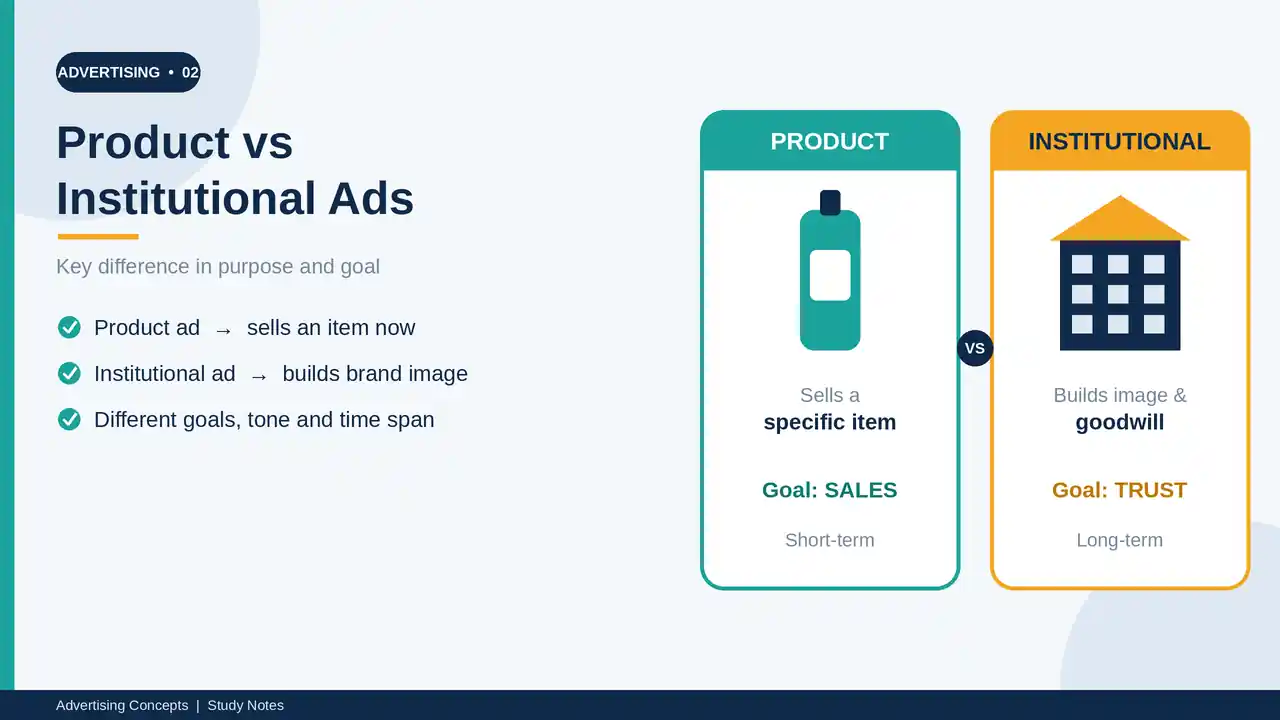
Product advertising promotes a specific product or service to drive a sale. Institutional advertising promotes the company itself, building reputation, trust, and goodwill rather than pushing one item.
Institutional advertising focuses on promoting the company or brand itself rather than a specific product. Product advertising tends to be short-term and goal-oriented, while institutional advertising is about long-term recognition and credibility. centricdxb usermaven
| Feature | Product advertisement | Institutional advertisement |
|---|---|---|
| Subject | One product or line | The whole organization |
| Main goal | Sales, sign-ups, trials | Reputation, goodwill, trust |
| Time horizon | Weeks to months | Years |
| Typical call to action | "Buy now," "Order today" | "Learn our story," "Join us" |
| Success metric | Conversions, revenue | Brand recall, sentiment |
| Audience | People ready to buy | Customers, employees, investors, the public |
Why the best brands use both
The two types are not rivals. They feed each other. One industry explainer describes a “halo effect”: a positive corporate image built through institutional campaigns makes a specific product ad more persuasive and trustworthy. climbtheladder
Here is a simple way to see it. Imagine two identical ads for a pair of running shoes. One comes from a brand you have heard of and respect. The other comes from a name you have never seen. Same message, very different response. Institutional advertising is what builds that difference.
When to lean on which
- Lean on a product advertisement when you are launching something, running a sale, or need measurable results fast.
- Lean on institutional advertising after a crisis, during a rebrand, or when you want people to understand what your company stands for.
- Blend them when a campaign sells a product while showing the values behind it, as many sustainability campaigns do.
3. Advertisements With Testimonials: Why Borrowed Voices Sell
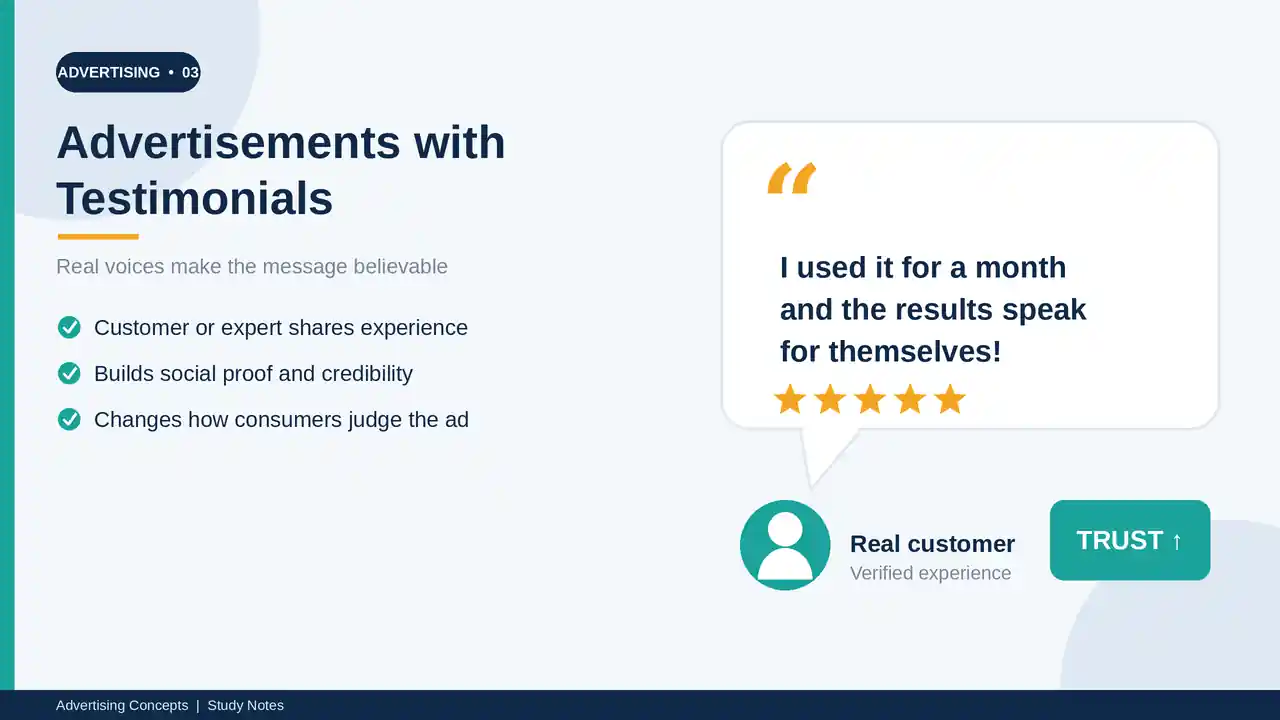
A testimonial is a statement from a real customer, expert, or user about their experience. Under the FTC’s rules, an endorsement must reflect the honest opinion of the endorser, which is why a testimonial feels more believable than a brand claiming it is great. ftc
Advertisements with testimonials work because they solve the biggest problem in advertising. Nobody believes the seller. A testimonial moves the claim from the seller’s mouth to a person who looks like the buyer.
The research behind it: five reviews change the odds
Northwestern University’s Spiegel Research Center studied how reviews affect buying behavior. One headline result: the purchase likelihood for a product with five reviews is 270% greater than for a product with none, and the effect is stronger for higher-priced items. northwestern
For a small seller, that is encouraging. You do not need hundreds of testimonials. A handful placed well can change results.
The finding almost nobody talks about: perfect ratings can hurt
Here is the unexpected part. You might assume a flawless 5.0 rating is ideal. The data says otherwise. Across more than 40 categories, purchase likelihood peaked when the average rating sat between 4.2 and 4.5 stars, then dropped as it approached a perfect 5. northwestern
The researchers’ explanation is human. When consumers see only five-star reviews, they suspect manipulation. The same research summary notes that earlier PowerReviews findings showed 82 percent of shoppers actively look for negative reviews. marketingsherpa northwestern
What does that mean for your advertisements with testimonials? Keep a mild, honest criticism in the mix. A testimonial that says “It took me an hour to set up, but it saved me ten hours a week” is more persuasive than “Perfect! Best ever!”
The legal rules: “results not typical” is no longer a shield
Many advertisers still print “results not typical” in tiny type under a dramatic story. The U.S. Federal Trade Commission has said that no longer protects you. After its 2009 revision of the Endorsement Guides, a disclaimer such as “results not typical” is no longer a safe harbor for claims made in testimonials. ftc
The practical rule: a testimonial about specific results should either reflect what consumers can typically expect or be paired with a disclosure of typical results. Simple opinion statements are treated differently. General statements such as “It tastes great” do not need a typical-results disclaimer. marketingsherpa marketingsherpa
Three habits keep you safe:
- Use only real customers and real words.
- Disclose payment, free products, or any connection to the brand.
- Do not let a testimonial say something you could not prove yourself. An endorsement cannot be used to make a claim the marketer could not legally make. ftc
If you advertise outside the U.S., check your local regulator. In India, for instance, the Advertising Standards Council of India (ASCI) publishes its own code, so review it before you publish.
4. Testimonial Advertising Is Consistent With Rights Theory: The Ethical Case
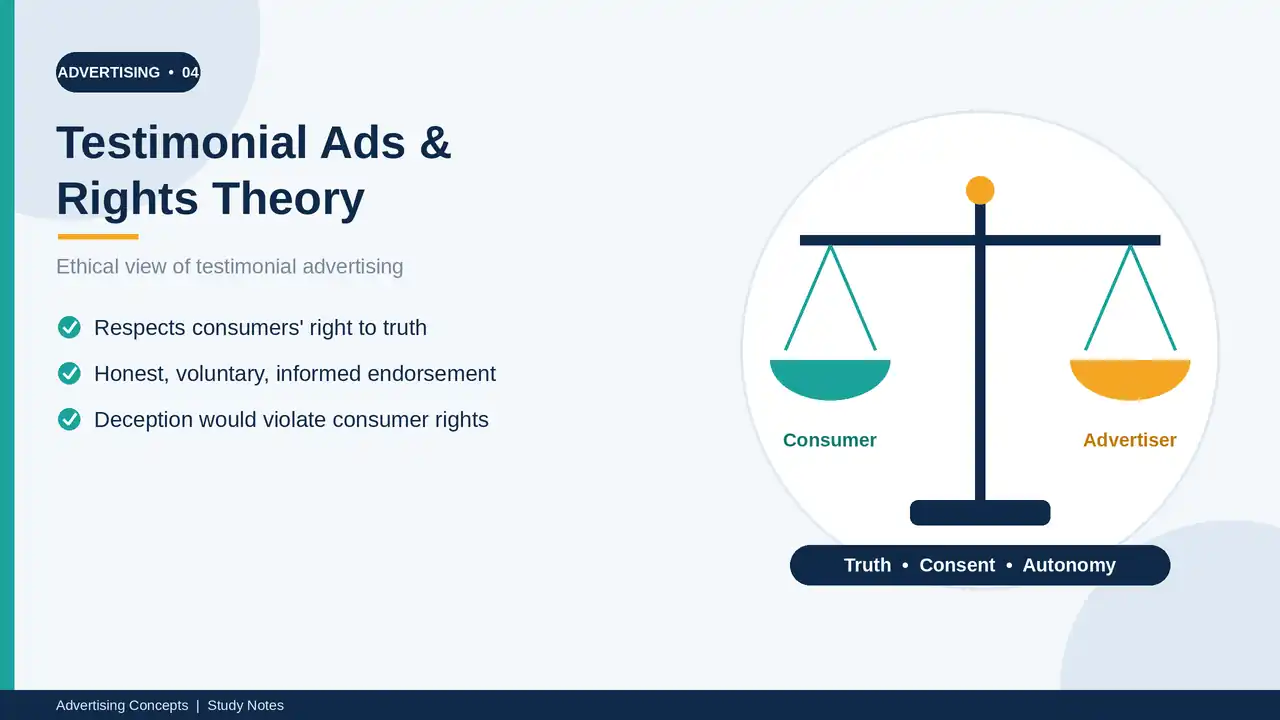
This is the angle most marketing blogs skip, and the one that gives your content real depth. To be clear, this section is my own analysis. It builds on published ethics research but does not quote any source as saying this directly.
What rights theory asks. Rights-based ethics, which draws on Kantian ideas, focuses on respecting people as free decision-makers. Applied to advertising, the key question is whether a message lets the consumer decide with accurate information, or whether it manipulates the decision.
The real academic debate. Philosophers have argued about this for decades. Robert Arrington concluded that advertising cannot be found guilty of intrinsically or frequently violating consumer autonomy. Roger Crisp took the opposite side, arguing that persuasive advertising can override autonomy by manipulating people without their knowledge. A later summary notes that there is still no clear consensus on the question. link.springer.com +2
Where testimonials fit. Testimonial advertising is consistent with rights theory when it meets three conditions:
- Truthfulness. The testimonial reflects a real experience. This protects the consumer’s right to accurate information, and it is the same standard the FTC enforces.
- Transparency. Any payment or relationship is disclosed, so the viewer knows how much weight to give the voice.
- Representativeness. The result shown is typical or clearly labelled otherwise, so the viewer can judge for themselves.
Under those conditions, a testimonial gives people more information, namely other people’s actual experience. It does not hide the process of persuasion. That is why I would argue it sits comfortably with a rights-based view.
Where it breaks down. Fake reviews, undisclosed paid endorsements, and cherry-picked miracle results all fail the test. They exploit trust rather than inform it. Crisp’s worry about manipulation applies most strongly to these cases.
So the ethical answer is not “testimonials are good” or “testimonials are bad.” It is “testimonials are ethical when they are honest, disclosed, and representative.”
5. Newspaper Advertising: Old Medium, Surprisingly Stubborn Trust
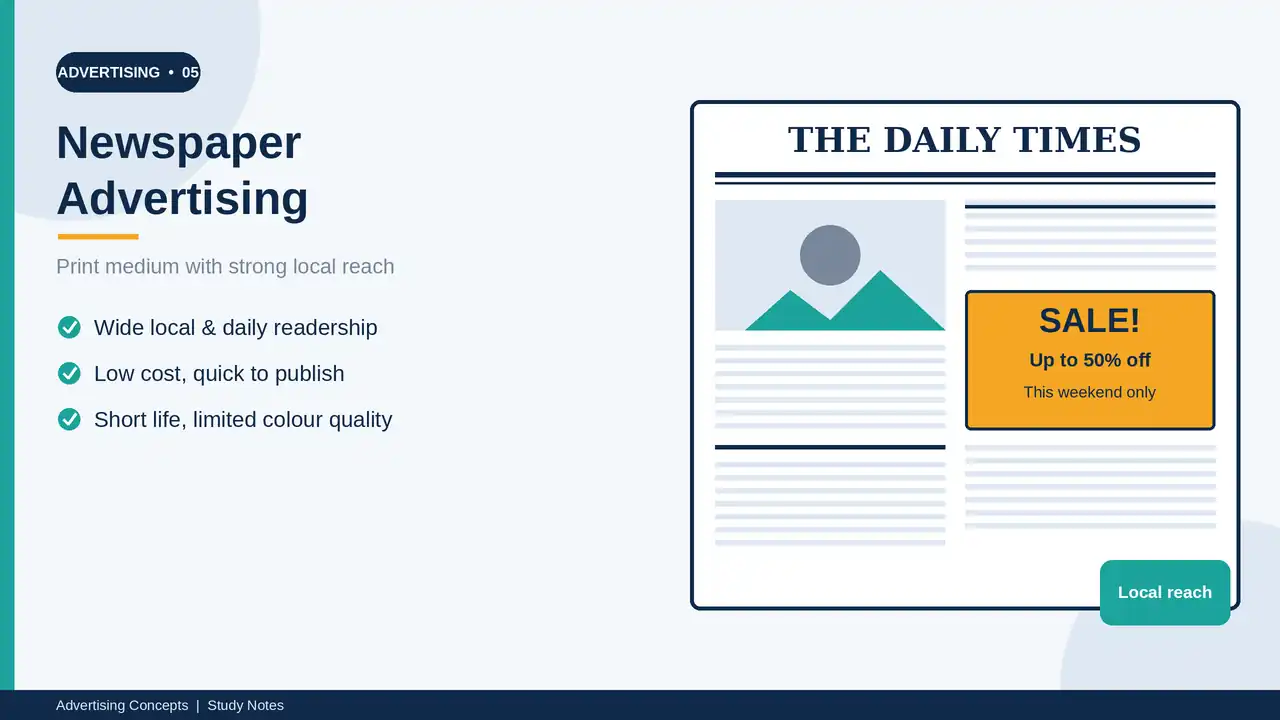
Newspaper advertising is often written off as dead. The numbers tell a more mixed story, and understanding both sides helps you decide whether it suits your product advertisement.
The trust advantage
Nielsen’s Global Trust in Advertising surveys have repeatedly found strong trust in print. In the 2015 edition, roughly six in ten global respondents said they completely or somewhat trust ads in newspapers (60%) and in magazines (58%). In an earlier 2013 report summarized by a newspaper trade group, 65 percent of respondents said they take action from an ad in a newspaper, compared with 50 percent for an online banner ad. nielsenpnrc
A caution: these are self-reported survey answers, and one source of the 2013 summary is a newspaper industry body. Treat them as indicators of trust, not guarantees of sales.
The reach problem
Trust does not equal audience. Pew Research Center reported that U.S. weekday newspaper circulation fell to 35 million in 2016, the lowest level since 1945, alongside a double-digit drop in advertising revenue to about $18 billion. Fewer readers means a smaller audience for every ad. pewresearch
Who should still use newspaper advertising
- Local businesses such as clinics, coaching centres, and real estate agents, because regional papers reach a defined area.
- Announcements and offers that need to look official, like admissions, public notices, and festival sales.
- Older and loyal-reader audiences, who still read the paper at the same time each day.
Tips for a stronger newspaper ad
- Put one clear offer in the headline.
- Add a trackable element, such as a unique phone number or coupon code, so you can measure results.
- Choose the section carefully. A coaching ad performs better near education news than near sports.
6. Advertising in Magazine: Slower, Richer, and More Targeted
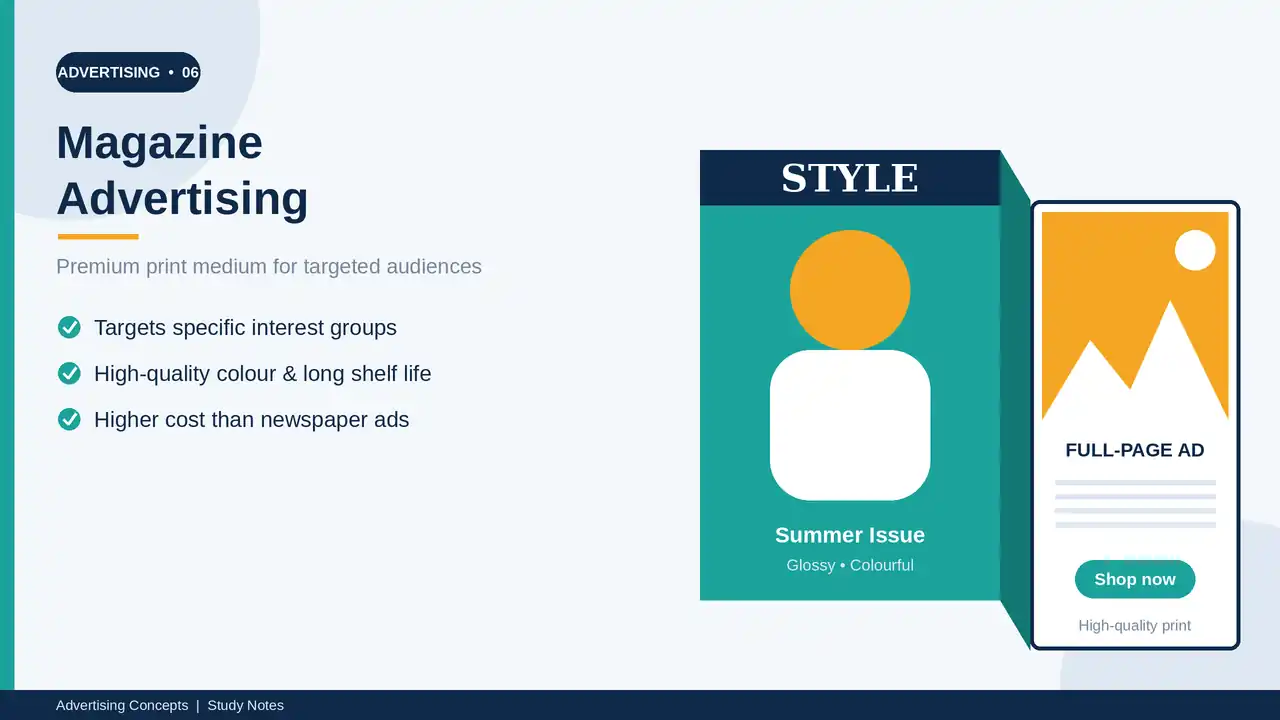
Advertising in a magazine works differently from a newspaper ad. Readers keep magazines for days or weeks, flip back to them, and pass them around. That gives your product advertisement a longer shelf life.
Why it works:
- Audience precision. A parenting magazine, a travel title, and a business monthly each deliver a tightly defined reader.
- Print quality. Colour reproduction and paper feel suit products where look and texture matter, such as fashion, food, and furniture.
- Credibility by association. Nielsen’s 2015 data above put magazine ad trust at 58% globally, close to newspapers.
What to watch:
- Lead times are long. You often book weeks ahead.
- Cost per reader can be high compared with digital.
- Measuring results is harder unless you add a code or a dedicated landing page.
A smart combination: pair print with testimonials
A print product advertisement with a short, honest customer quote can do something a banner ad cannot. It gives the reader time to sit with the claim. Add a QR code to a fuller review page, and the printed ad becomes a bridge to your online store.
How to Build a Product Advertisement That Works: 6 Steps
Here is a practical process you can use today:
- Define one goal. Sales, sign-ups, or store visits. Choose one.
- Know the reader. Write down their problem in their own words, not yours.
- Lead with the benefit. “Plan a week of lessons in 20 minutes” beats “Comprehensive lesson planning solution.”
- Add proof. One or two truthful testimonials, ideally with a name, role, and a mildly specific detail.
- Pick the channel that fits. Newspaper for local trust, magazine for a focused audience, digital for tracking.
- Measure and revise. Use coupon codes, unique links, or phone numbers to see what each ad produced.
If you want a real-world testing ground, a niche marketplace is useful. A seller on the [Online Marketplace for Teachers], for example, can test two product advertisements with different testimonials and see which one brings more downloads.