

Source: [Skydo_Official] (YouTube)
Most sellers pick a marketplace the way people pick a restaurant in a strange city: they go where the crowd is. Amazon because everyone has heard of it. Etsy because a friend made money there. Shopify’s app store, eBay, Facebook Marketplace, and so on.
It’s an understandable instinct, and it’s often expensive.
A marketplace is a business relationship, not just a sales channel. It controls who sees your products, how much of each sale you keep, and whether you ever get to know your own customers. Pick the wrong one and you can work hard for years and still own almost nothing.
This guide walks through how to choose the right marketplace for your business, using a framework you can apply in an afternoon. We’ll also cover what to do if you’d rather build your own platform, why seller-owned “collective” models are quietly gaining ground, and how to increase customer retention in marketplaces, which is where most of the long-term money is.
2. What Does "Choosing the Right Marketplace" Actually Mean?
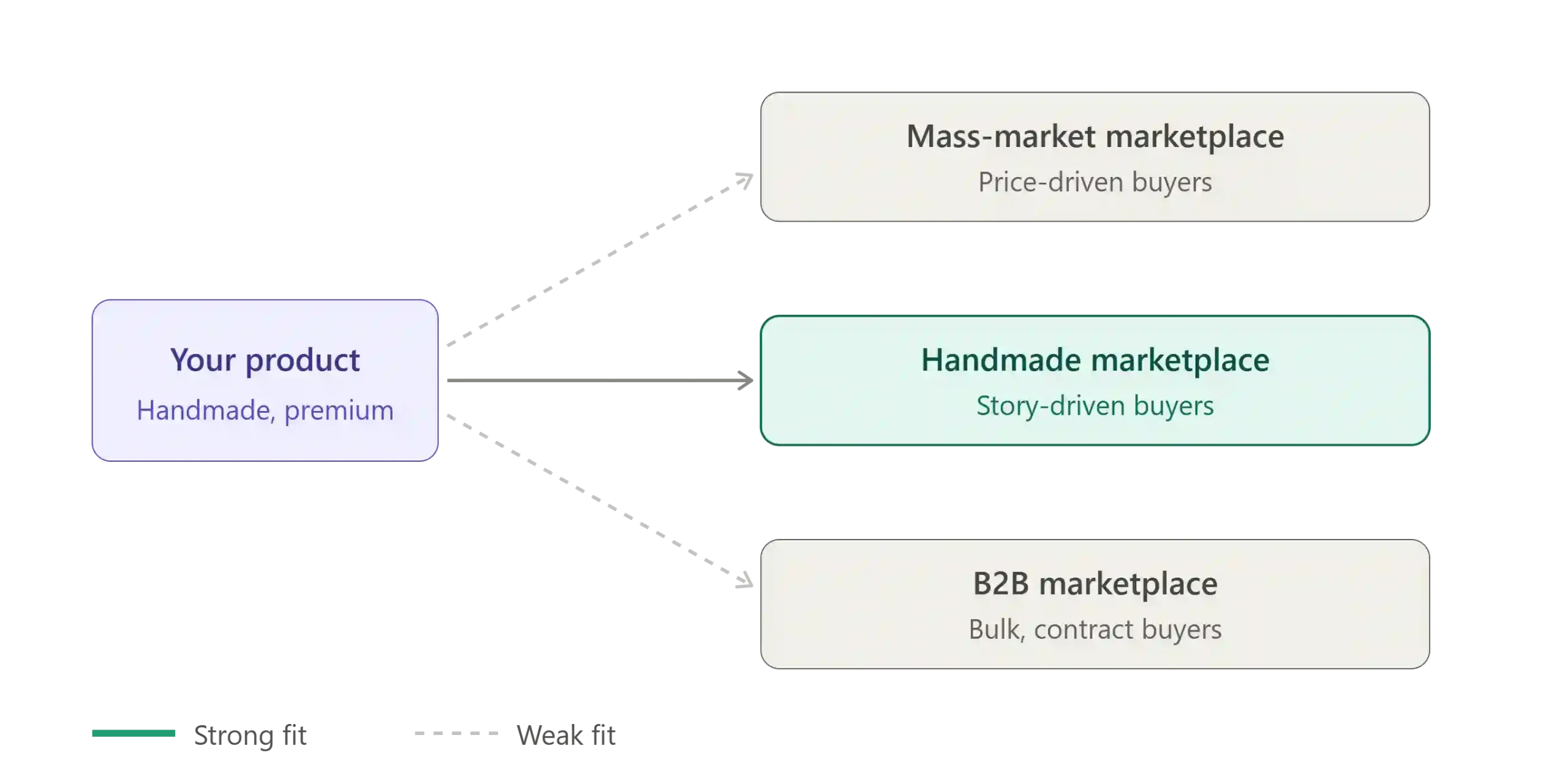
Quick answer: Choosing the right marketplace means finding the platform where your target buyers already search for what you sell, where the total cost of selling still leaves you a healthy margin, and where you keep enough control over customer relationships to build a durable business.
Notice that “biggest” isn’t in that definition. Size matters less than fit.
Economists who study platforms call this the network effect. Geoffrey Parker, Marshall Van Alstyne, and Sangeet Paul Choudary explain in their book Platform Revolution (2016) that a platform becomes more valuable as more of the right participants join. The key words are “the right.” A marketplace with 100 million shoppers who want mass-produced phone cases is worth very little to a seller of hand-dyed silk scarves.
So the real question isn’t “Where are the most buyers?” It’s “Where are the most buyers who want what I sell, at the price I need?”
3. Step-by-Step: How to Choose the Right Marketplace for Your Business
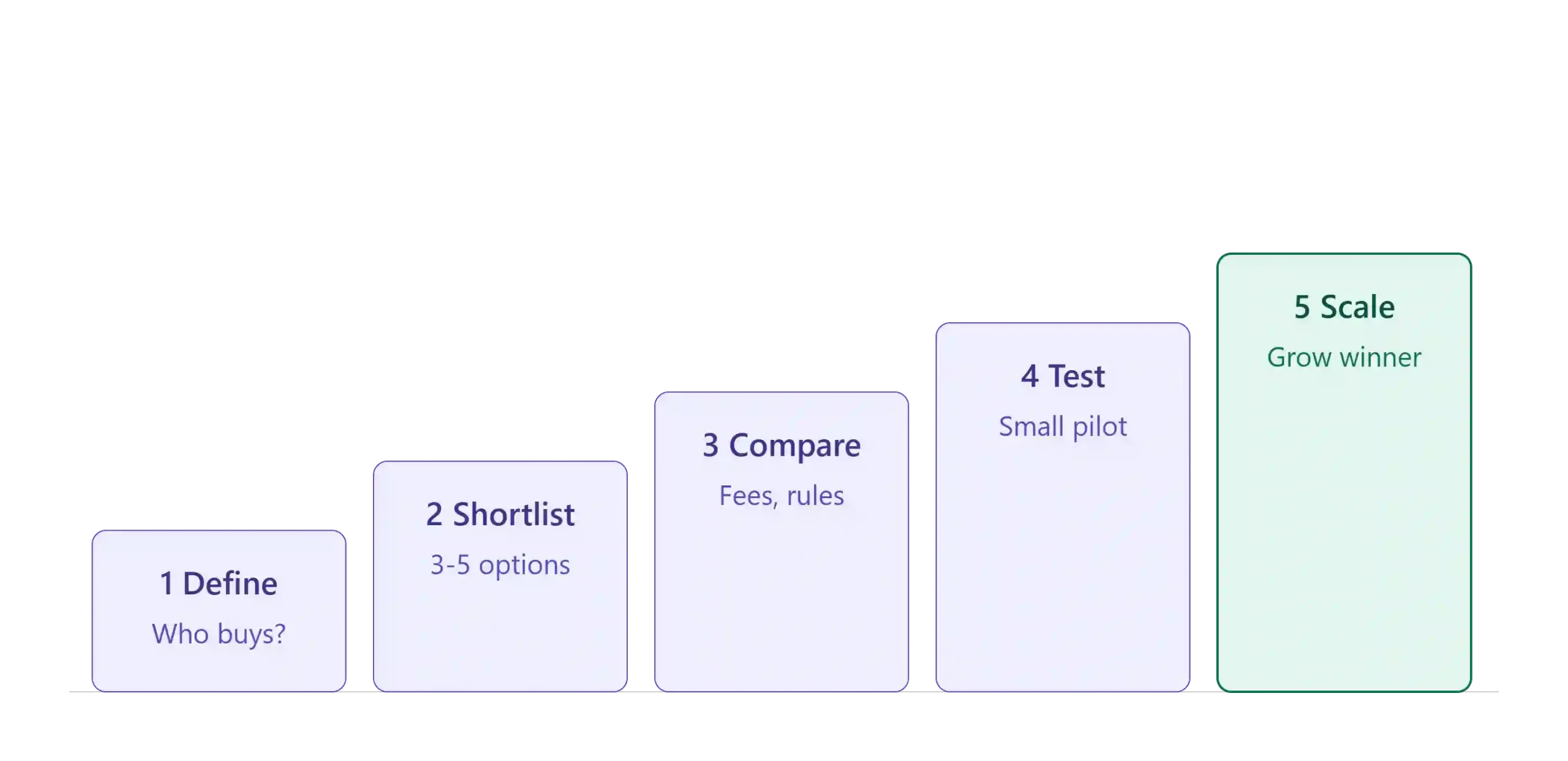
Step 1: Define your buyer before you define your platform
Write down who buys from you, what they’re trying to solve, and where they currently look. If you can’t answer that, no marketplace comparison will help.
A quick test: ask five recent customers, “Where did you look before you found me?” Their answers are better market research than any report.
Step 2: Calculate your effective take rate, not the advertised one
This is where most sellers get burned, and where the unexpected insight lives.
Marketplaces advertise a headline fee, such as a referral fee, listing fee, or commission. But that’s rarely what you pay. The real number, sometimes called the effective take rate, includes advertising you feel pressured to buy, fulfillment fees, payment processing, returns, and penalties.
Marketplace Pulse, the research publication run by Juozas Kaziukėnas, has reported that Amazon’s combined fees and advertising can consume roughly half of a typical third-party seller’s revenue. Amazon’s own shareholder letters note that third-party sellers now account for around 60% of units sold on the site. Put those two facts together and you see the business model: the sellers are doing much of the work, and the platform collects a large share of it.
Etsy shows the same pattern on a smaller scale. In April 2022 it raised its transaction fee from 5% to 6.5%, which sparked a widely reported seller strike. It also charges an Offsite Ads fee, currently a percentage of the sale, when a buyer arrives through one of its ads. Sellers who only looked at the listing fee missed those costs.
Here’s a simple way to calculate your own effective rate:
- Take your total sales on the platform for a month.
- Add up everything paid to the platform (fees, ads, shipping labels, storage, payment fees, returns processing).
- Divide costs by sales.
If the answer is above 35 to 40% and your product margin is thin, you’re running a charity for the platform.
Step 3: Check category fit and competition density
Some marketplaces are broad, like Amazon and eBay, and some are narrow, like Etsy for handmade goods, Reverb for musical instruments, or Faire for wholesale. Narrow platforms often deliver better-quality buyers, but broad ones deliver volume.
Ask two questions:
- Is my category already crowded with identical products? If so, price becomes the only differentiator, and you’ll lose to the seller with the lowest costs.
- Does the platform’s audience expect what I sell? Buyers on Etsy expect story and uniqueness. Buyers on Amazon often expect speed and a low price.
Step 4: Ask who owns the customer
This single question separates a good marketplace partnership from a dependency.
On some platforms you never receive the buyer’s email address. You can’t follow up, invite them to a newsletter, or sell them anything new without paying again. Others let you include your own packaging inserts or drive buyers to your own store.
Before you commit, read the policies on messaging, data access, and off-platform contact. If you can’t build a relationship, you’re renting customers, not earning them.
Step 5: Plan your exit from day one
Good marketplace sellers treat the platform like a launchpad. Use it for discovery and early cash flow, then steadily move your best customers toward channels you control, such as an email list, your own website, or repeat-order programs.
Nobody likes hearing this, but if a platform changes its algorithm or fees tomorrow, your business should survive it.
4. What Is the Best Marketplace? It Depends on What You Sell
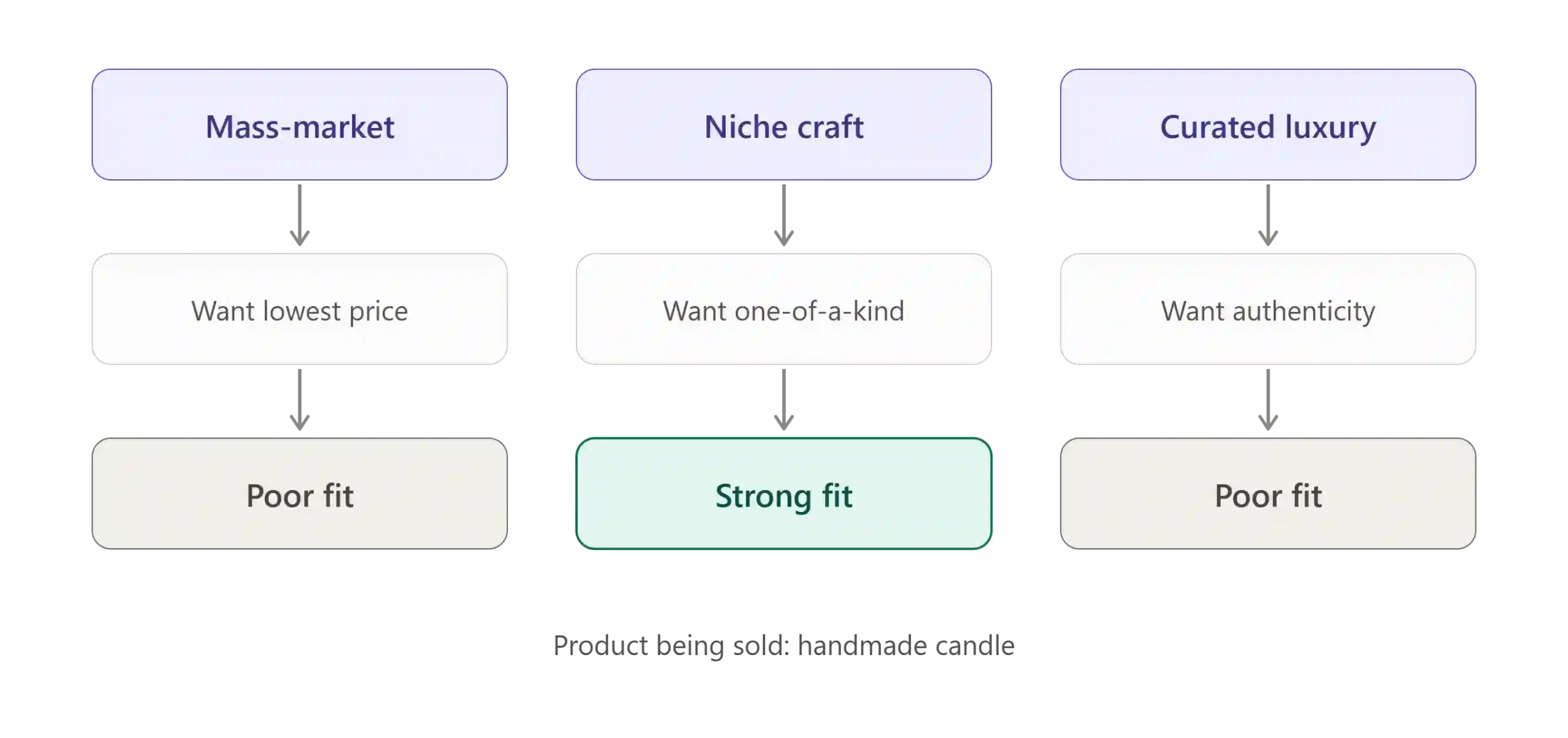
People search for the “best marketplace” as if there were one winner. There isn’t. There’s a best match for your situation. Here’s a rough guide:
| If you sell… | Consider… | Why |
|---|---|---|
| Handmade, vintage, or craft goods | Etsy | Buyers expect uniqueness and will pay for it |
| Everyday consumer products at scale | Amazon | Unmatched reach, but high competition and costs |
| Wholesale to independent shops | Faire | Retailers come to buy, not browse |
| Used electronics, collectibles | eBay | Strong auction and collector culture |
| Local items, furniture, used goods | Facebook Marketplace | No listing fees for most local sales, built-in audience |
| Freelance or creative services | Upwork, Fiverr, Toptal | Varying quality tiers and fee structures |
| Stock photography or digital art | Stocksy United or Adobe Stock | Different royalty and ownership models |
A caution: fee structures and policies change often. Always check the platform’s current seller terms before deciding, because numbers that were true last year may not be true now.
Another tip that rarely appears in “best marketplace” lists is to start on one platform and do it well. Sellers who spread across six marketplaces at once usually do six mediocre jobs, then blame the platforms.
5. The Marketplace Collective: A Model Most Sellers Haven't Considered
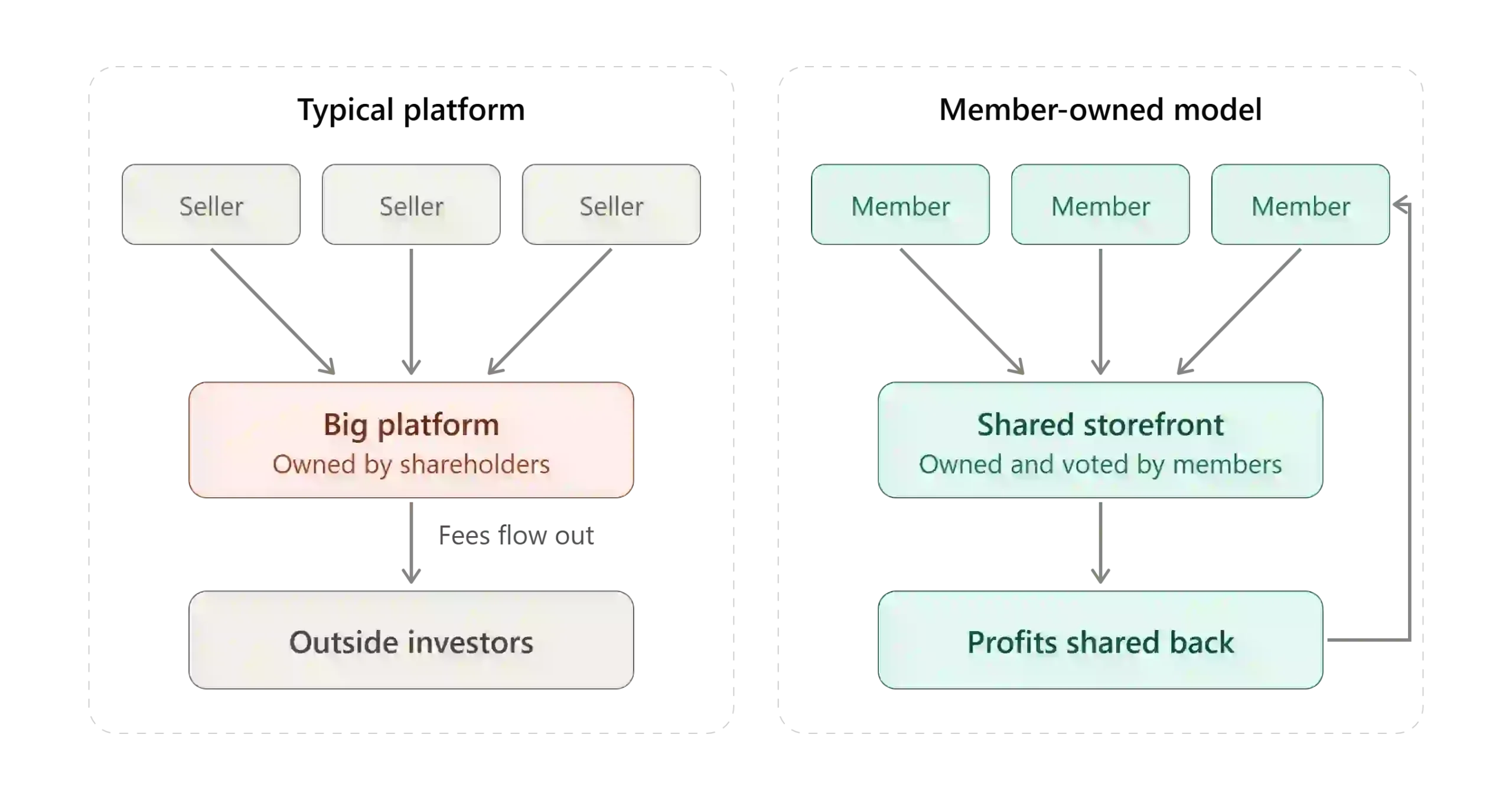
Here’s something you won’t find in most marketplace guides. There’s a third option between “sell on someone else’s platform” and “build your own from scratch”: the marketplace collective.
A marketplace collective is a platform owned and governed by the people who use it, usually sellers, sometimes buyers, often both. Instead of profits flowing to outside shareholders, they’re shared among members or reinvested in the platform.
Real examples exist:
- Stocksy United is a stock photography cooperative based in Canada, owned by its artist members. Photographers keep a much larger share of each license fee than they typically would on traditional stock sites, and members share in the co-op’s profits.
- Fairmondo is a German online marketplace structured as a cooperative, founded as an ethical alternative to large retail platforms.
- Platform cooperativism, a movement championed by Trebor Scholz at The New School, argues that digital platforms should be collectively owned by workers and users. Scholz has written widely on the idea, and the concept has spawned dozens of small experiments around the world.
Is this right for everyone? No. Collectives tend to have smaller audiences than giants like Amazon, and governance takes time. But for certain businesses, such as artists, independent service providers, and local producers, a collective can offer lower fees, more transparency, and a voice in how the rules are written.
If you’re a seller who’s tired of rule changes you can’t influence, a marketplace collective is worth a serious look. You can also start one with a small group of peers who sell complementary products to the same audience, sharing a storefront, marketing costs, and customer lists.
6. How to Create a Marketplace Website (If You'd Rather Build Than Rent)
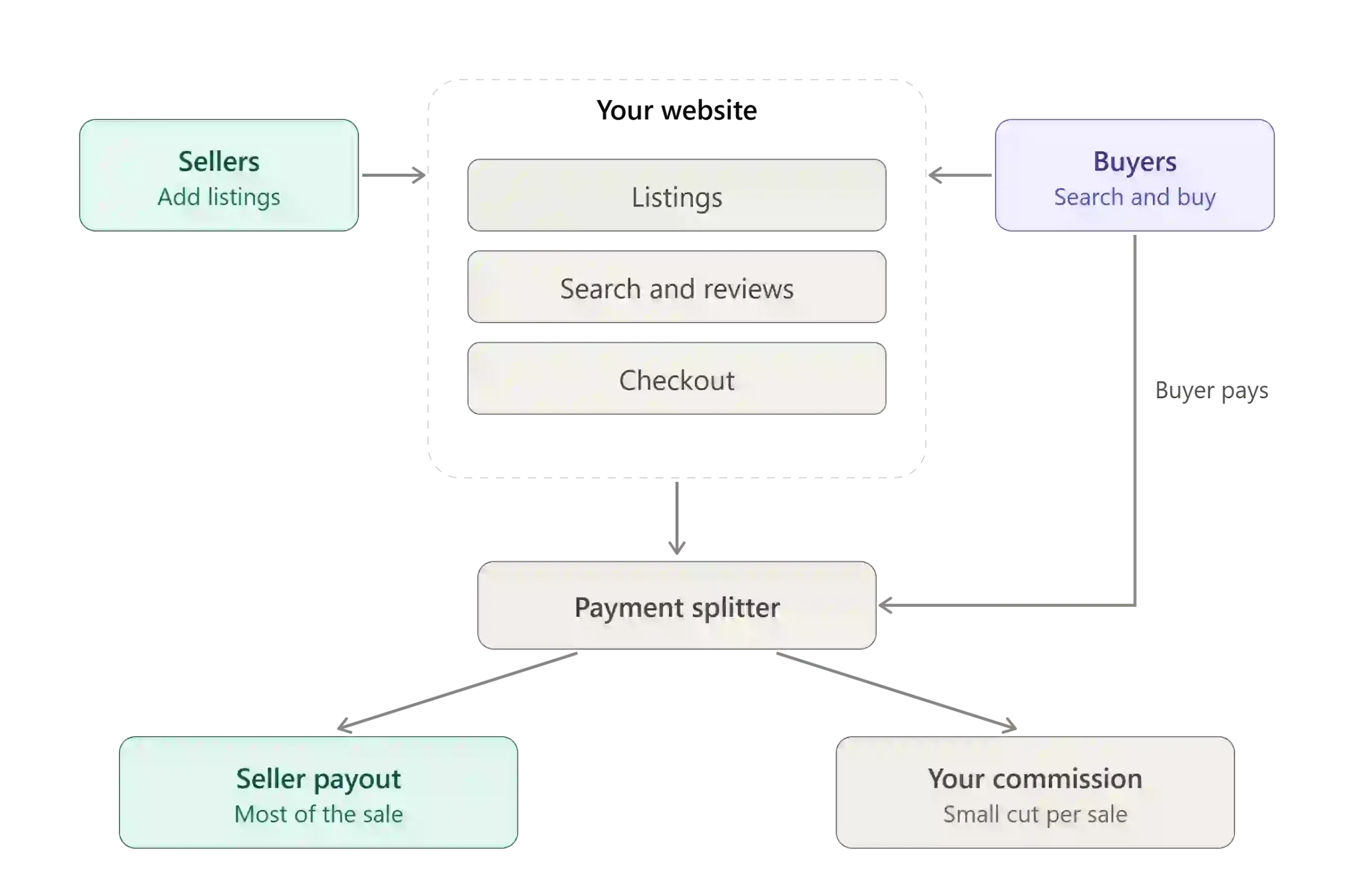
Sometimes the right answer is to build your own. If you have a clear niche and an audience you can reach, running your own platform gives you control that no third-party marketplace will.
Here’s how to create a marketplace website in plain terms.
Choose your build approach
- Marketplace software (low code): Tools like Sharetribe, Arcadier, or Shopify-based multi-vendor apps let you launch fast with limited technical skill. Good for testing an idea.
- Enterprise platforms: Mirakl and similar providers power marketplaces for large retailers, at a much higher cost.
- Custom development: Maximum flexibility, maximum expense. Usually only worth it once you’ve proven demand.
Solve the chicken-and-egg problem first
Every new marketplace faces the same trap: buyers won’t come without sellers, and sellers won’t come without buyers. Andrew Chen, a partner at Andreessen Horowitz, wrote at length about this in his book The Cold Start Problem (2021). His main idea is to start with a very small, tightly focused “atomic network,” one that can work on its own.
Historic examples show how this works. Airbnb’s founders famously flew to New York and personally photographed hosts’ apartments, because listings with professional photos booked much better. Uber launched in San Francisco only before expanding city by city. They didn’t try to be everywhere. They tried to be useful somewhere.
Your version might be one neighborhood, one product category, or one community. Don’t launch broad. Launch deep.
Focus on liquidity, not traffic
Liquidity means how likely it is that a buyer finds what they want and a seller makes a sale. Venture investors at Andreessen Horowitz have long pointed to metrics like the percentage of listings that sell, and the time it takes to sell, as better health signals than raw visitor numbers. Ten thousand visitors who find nothing to buy is a problem, not a win.
Plan how money will flow
Decide early how you’ll earn: commission per sale, subscription for sellers, listing fees, or featured placement. Use a payment system built for marketplaces (Stripe Connect is a well-known option) so you can split payments between sellers and yourself without handling every transaction by hand. Also check local regulations on payments, taxes, and consumer protection, since marketplace operators often carry legal responsibilities their sellers don’t.
7. How to Increase Customer Retention in Marketplaces
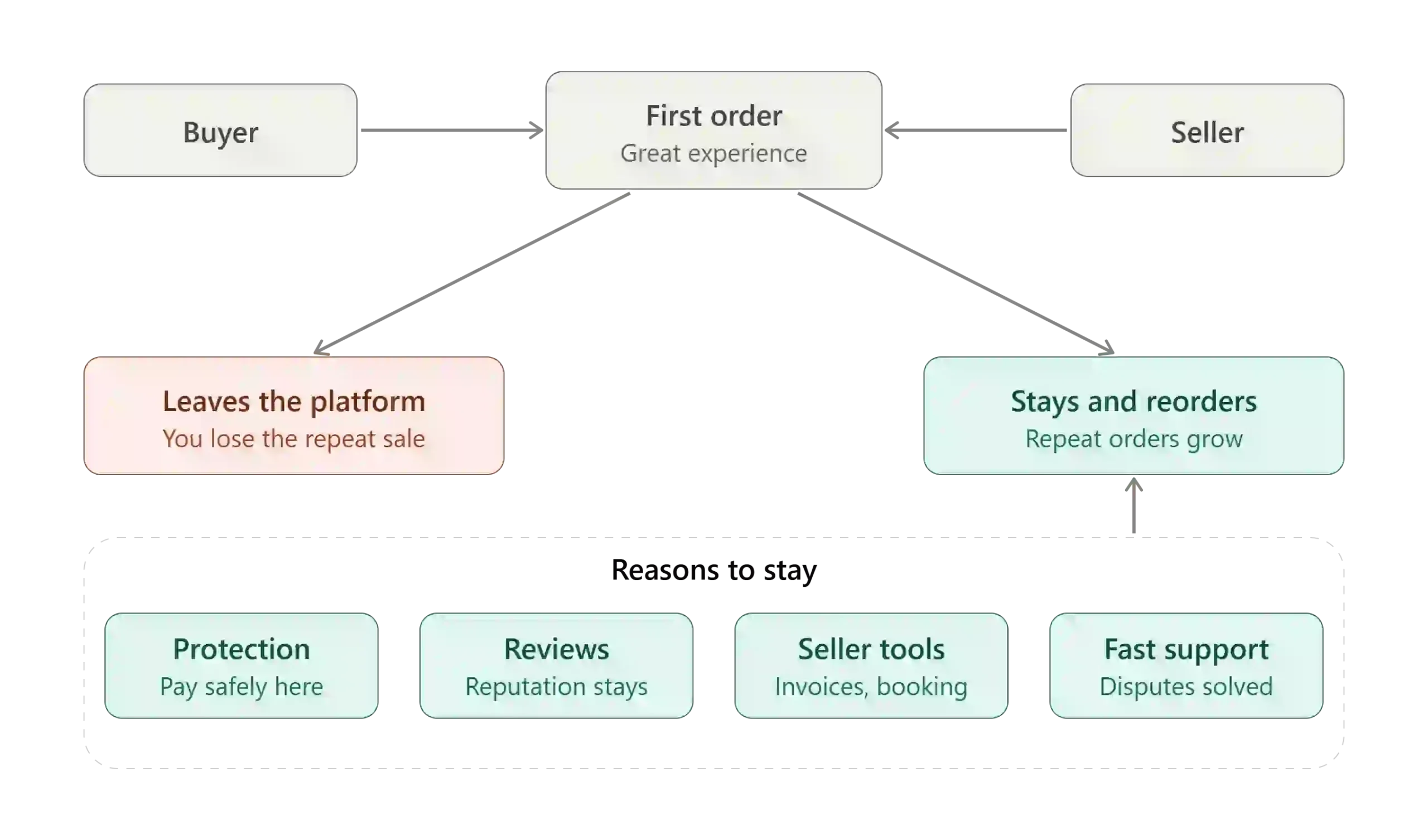
Whether you sell on a marketplace or run one, retention decides who wins. Acquiring a customer is expensive. A Harvard Business Review article by Amy Gallo, “The Value of Keeping the Right Customers” (2014), summarizes research suggesting it costs several times more to acquire a new customer than to keep an existing one. Bain & Company’s Frederick Reichheld, who popularized the idea, argued that small retention gains can lift profits significantly. Exact multiples vary by industry, but the direction is well established.
The marketplace-specific problem: leakage
Here’s the unusual part. Marketplaces face a problem that normal stores don’t: leakage, also called disintermediation. That’s when buyer and seller meet on your platform, then take future transactions elsewhere to dodge fees.
It’s most common in service marketplaces, where the relationship matters more than the platform. Think home cleaning, tutoring, or freelance design. After the first great experience, why would a customer keep paying a commission?
The smartest marketplaces solve it by making staying more valuable than leaving, not by banning contact. Here’s how.
Seven ways to keep customers coming back
- Protect the transaction. Offer payment protection, guarantees, or insurance. Buyers pay a bit more for the safety net, and going off-platform means losing it.
- Add tools beyond the marketplace. Scheduling, invoicing, and reviews that sellers can’t easily replicate elsewhere.
- Make reviews portable only on-platform. Reputation is an asset sellers don’t want to abandon.
- Personalize after the first purchase. Recommend related items, remind buyers of repeat needs, and let them save favorites.
- Reward loyalty without gimmicks. A small discount on the second purchase works better than a complicated points system nobody understands.
- Fix problems fast. A quickly resolved complaint often builds more loyalty than a flawless order. Speed and fairness in dispute handling are underrated retention tools.
- Retain sellers, too. In a marketplace, unhappy sellers leave, taking their inventory with them. Regularly ask sellers what’s slowing them down.
If you’re a seller on someone else’s platform
Retention is trickier because you don’t control the customer data. Still, you can:
- Include a thank-you card with a QR code to your own site or email signup (check the platform’s rules first).
- Make packaging memorable enough that buyers remember your brand, not the marketplace.
- Respond to every review, good or bad.
- Offer bundles or refills that naturally bring people back.
Common Mistakes to Avoid
- Chasing every marketplace at once. Depth beats breadth.
- Ignoring the total cost. Always calculate the effective take rate.
- Skipping the fine print. Account suspension policies matter more than most sellers realize. Read them before you invest in inventory.
- Racing to the bottom on price. If you can’t win on cost, win on uniqueness, service, or brand.
- Having no plan B. A single platform should never be your only income source.
Frequently Asked Questions
1. Which marketplace has the lowest fee structure for new sellers?
Etsy and eBay generally offer lower upfront entry barriers compared to Amazon. Etsy charges a flat listing fee per item ($0.20) plus transaction fees, while eBay offers free listings up to a specific limit before charging insertion and final value fees. Amazon requires a monthly subscription for its Professional account alongside category-specific referral fees.
2. Can I sell on multiple marketplaces simultaneously, or should I stick to one?
Multi-channel selling is highly recommended to diversify risk, but you should start with one platform first to master inventory and logistics. Once established, use multi-channel integration software (like Shopify, Channable, or web platforms) to sync your inventory automatically across other platforms and avoid stockouts.
3. How do I decide between Amazon and niche marketplaces like Etsy or Myntra?
Choose Amazon if you sell high-volume, standard consumer goods where fast shipping and massive traffic matter most. Choose a niche marketplace if your product relies heavily on brand identity, craftsmanship, or storytelling (e.g., Etsy for handmade goods, Myntra or Ajio for curated fashion), as they offer better brand control and targeted buyers.
4. Do I lose ownership of my customer data when selling on a marketplace?
Yes, mostly. Large marketplaces like Amazon and Walmart hide customer email addresses and strictly prohibit redirecting buyers to your external website. If building a long-term brand database is your primary goal, you should run a standalone website (like Shopify) alongside your marketplace channels.
5. Is it better to use the marketplace's fulfillment service (like Amazon FBA) or ship items myself?
Use marketplace fulfillment (FBA or Flipkart Assured) if your products are fast-moving, standard-sized, and you want to qualify for premium badges that boost search visibility. Opt for self-fulfillment if your products are fragile, oversized, customized, or have low profit margins that cannot absorb platform storage fees.
[…] AI Video Generation Tools for Product Listings How to Choose the Right Marketplace for Your Business: A Practical Guide for 2026 Advance Search Explained: How Face Search Engines and People Intelligence Platforms Really Work […]