
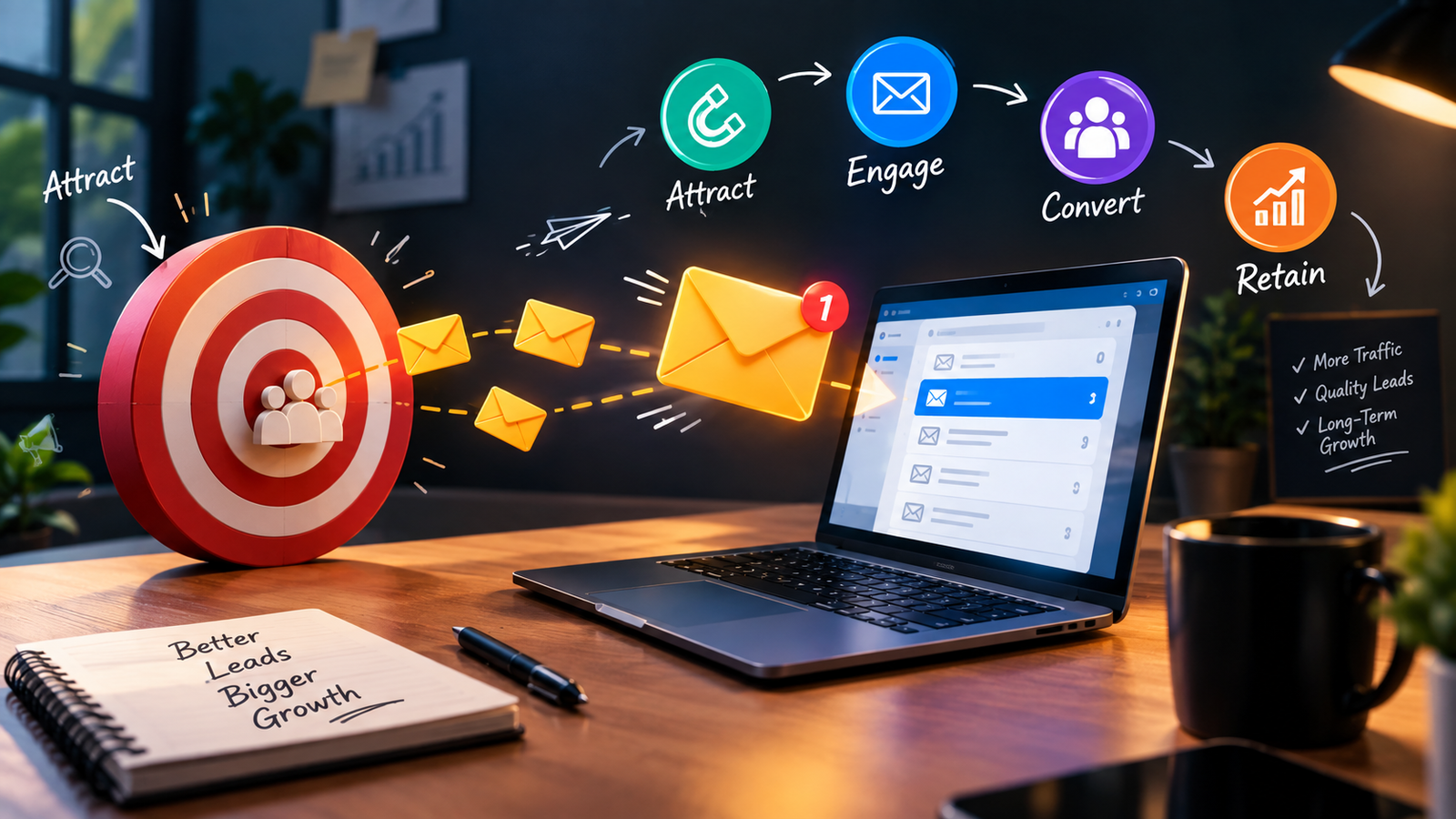
A visitor discovers your website through Google, reads an article, and leaves without making a purchase or contacting your business. That does not necessarily mean the opportunity is lost.
With the right email strategy, that first visit can become the beginning of a longer customer journey. A useful guide, newsletter, product update, or personalized recommendation can bring people back when they are more prepared to take action.
This is where email fits into inbound marketing. Instead of relying entirely on paid promotion to reach people again, businesses can continue communicating with subscribers who have already shown an interest.
In 2026, however, successful campaigns require more than attractive templates and promotional offers. Audience segmentation, automation, personalization, deliverability, and meaningful measurement all play a role. The focus is shifting from sending more messages to sending messages that have a clear reason to exist.
1. What Is Inbound Email Marketing?
Inbound email marketing starts with permission and interest.
A person may subscribe after reading a blog, downloading a report, signing up for a webinar, creating an account, or purchasing a product. The business can then use email to provide information that matches the subscriber’s needs.
Consider a company selling project-management software. Someone downloads its guide to managing remote teams. The first follow-up could deliver the guide, the next could explain common workflow problems, and another could demonstrate how the software addresses those problems.
The subscriber is not being pushed directly into a sale. Instead, each message helps answer a question that may arise during the buying process.
That approach makes email a continuation of the inbound journey rather than a separate promotional activity.
2. How Can Email Marketing Fuel Your Overall Inbound Strategy?
Email can connect several marketing activities that otherwise operate independently.
SEO may bring someone to a website, content may establish expertise, and social media may create awareness. Email provides a way to continue that relationship after the initial interaction.
1. Convert Interest Into a Known Lead
Website traffic is valuable, but anonymous visitors are difficult to nurture.
Offering something genuinely useful in exchange for an email address gives a business a way to continue the conversation. Depending on the audience, that incentive could be a research report, checklist, product guide, webinar, discount, or industry newsletter.
The quality of the offer matters. A visitor is unlikely to provide contact information simply because a website asks for it.
2. Build a Relevant Nurturing Journey
Not every prospect is ready to buy immediately.
Automated sequences can provide information over time while allowing businesses to respond to customer behavior. Someone who repeatedly clicks product-related content may need different communication from a subscriber who only reads educational articles.
This makes behavioral triggers more useful than a fixed sequence that sends exactly the same messages to everyone.
3. Extend the Reach of Valuable Content
A well-researched article may receive search traffic for months, but email can put that content directly in front of an interested audience.
The email should add context instead of merely saying, “We published a new article.”
For example, a cybersecurity company could send subscribers a short explanation of a newly discussed security issue and then link to its detailed guide. The email becomes useful on its own while also encouraging readers to explore deeper content.
4. Connect Marketing With Revenue
Email performance should ultimately be connected to a business objective.
For an ecommerce company, that could mean completed orders. A B2B company might care more about qualified leads or booked demonstrations. A SaaS business could measure trial activations and paid conversions.
This distinction matters because a campaign can generate plenty of clicks without producing meaningful business results.
3. Is Email Marketing Dead?
The short answer is no.
Email continues to be used for newsletters, customer communication, ecommerce, subscriptions, product information, and retention. The problem is not the channel itself; it is the growing amount of low-value communication competing for people’s attention.
A subscriber who receives irrelevant promotions several times a week has an obvious reason to unsubscribe. Someone receiving useful information at appropriate intervals has a stronger reason to remain subscribed.
Modern campaigns therefore tend to emphasize:
- Audience relevance
- Permission-based communication
- Useful content
- Timely automation
- Clear calls to action
- Strong deliverability
- Measurable outcomes
The important question is whether an email gives the recipient a reason to open, read, and act on it.
4. Email Marketing Update in 2026: Key Changes Marketers Should Know
The email landscape is becoming more technical as well as more personalized.
1. AI Is Supporting Campaign Work
AI can assist with tasks such as generating content variations, analyzing campaign data, suggesting subject lines, and identifying audience patterns.
There is an important limitation, though: faster content creation does not automatically produce better marketing.
A poorly defined audience, inaccurate customer data, or weak offer can still result in a poor campaign, regardless of how advanced the software is. Human review remains important for accuracy, tone, brand consistency, and judgment.
2. Personalization Goes Beyond First Names
Adding a subscriber’s name to an email is only basic personalization.
More useful approaches can consider purchase history, browsing behavior, product interests, location, engagement level, or lifecycle stage.
For example, an online electronics retailer could recommend accessories based on a customer’s previous purchase instead of promoting its entire catalog to everyone.
The trade-off is data responsibility. More personalization requires better customer data, and businesses should only use information appropriately and transparently.
3. Deliverability Has Become a Marketing Issue
A carefully written campaign cannot perform if it repeatedly lands in spam or fails to reach recipients.
Google requires email authentication practices for messages sent to Gmail users, with additional requirements for bulk senders. Yahoo also places emphasis on authentication and sender reputation.
This makes technical configuration part of the marketing process. Authentication, list quality, bounce rates, complaints, and sending behavior can all affect whether campaigns reach the intended audience.
4. Open Rates Are Not Enough
An open rate can provide a useful signal, but it should not be treated as the final measure of success.
Depending on the campaign, marketers may need to examine:
- Click-through rate
- Conversion rate
- Revenue
- Leads generated
- Unsubscribe rate
- Bounce rate
- Customer retention
For example, an email with fewer opens but a much higher purchase rate may be more valuable than a widely opened message that produces no conversions.
5. How to Know Competition Email Marketing Effect
You cannot normally access a competitor’s private analytics, revenue figures, or conversion data. However, you can study what their customers can see.
Start by joining their public mailing lists and documenting their campaigns over several weeks.
Look at:
- Sending frequency
- Subject lines
- Content themes
- Promotional offers
- Calls to action
- Personalization
- Design
- Landing pages
- Follow-up messages
The journey after clicking an email can be particularly revealing.
Suppose a competitor promotes a free consultation. Does the link lead to a detailed landing page, a short booking form, or a generic homepage? How many steps are required before completing the desired action?
This type of observation can help identify weaknesses and opportunities without pretending to know metrics that are not publicly available.
Competitive research should inform your experiments, not turn into direct copying.
6. Guide for Email Marketing Software vs Competition
Choosing an email platform is less about finding the software with the longest feature list and more about matching the platform to your workflow.
A small publication may only need newsletters, basic segmentation, and reporting. An ecommerce operation with thousands of customers may require behavioral triggers, abandoned-cart automation, purchase-based recommendations, and deeper integrations.
When comparing platforms, consider these areas.
1. Automation
Check whether the system can handle welcome campaigns, onboarding, abandoned carts, post-purchase communication, and re-engagement.
2. Segmentation
Look for flexible audience rules based on behavior, purchases, interests, engagement, or customer status.
3. Analytics
The platform should make it possible to evaluate the metrics that matter to your business rather than focusing exclusively on opens.
4. Integrations
Consider whether the software connects with your website, CRM, ecommerce platform, analytics tools, and other systems already in use.
5. Deliverability
Authentication support, bounce management, list hygiene, and reputation-related tools can become increasingly important as your sending volume grows.
6. Pricing
Do not compare only the entry-level plans. Estimate what the platform will cost when your subscriber database becomes significantly larger.
The cheapest option today may not remain the cheapest option after your business grows.
7. Automotive Email Marketing: Keeping Customers Engaged After Purchase
The relationship between an automotive business and its customers can continue long after a vehicle is sold.
Dealerships and related businesses can use email for service reminders, maintenance information, test-drive invitations, new-model announcements, warranty communication, accessories, and feedback requests.
Timing is particularly important.
Someone who recently purchased a vehicle may be interested in onboarding information, while an existing customer approaching a scheduled service may need a reminder instead.
Sending both groups the same promotional campaign wastes the opportunity to make the message more relevant.
Customer history can therefore be more valuable than simply knowing a person’s name.
8. Logistics Email Marketing: Useful Communication Across the Delivery Cycle
Logistics businesses have a natural use case for email because customers often need information at several stages of an order or shipment.
Messages can cover shipment progress, delivery notifications, account information, service changes, onboarding, and operational updates.
There is also a broader B2B opportunity.
A logistics provider can publish useful content around subjects such as supply-chain efficiency, delivery planning, inventory movement, or international shipping. Subscribers who consistently engage with this material may become potential sales leads over time.
The strongest approach is to separate operational messages from promotional campaigns. A customer checking a delivery update should be able to find the information they need immediately.
9. Local Email Marketing: Building Stronger Customer Connections
For businesses that serve a particular area, location can be a useful segmentation factor.
Restaurants, gyms, salons, retailers, service providers, and other local companies can use email to promote nearby events, seasonal services, appointments, loyalty benefits, or branch-specific announcements.
Imagine a business operating five locations. Sending an invitation for a Saturday event at one branch to its entire database may create unnecessary noise. Sending it only to relevant subscribers makes the communication more useful.
Frequency also matters. Local businesses do not need to email customers constantly to remain visible. A smaller number of timely, relevant messages can be more effective than a crowded inbox.
10. How to Build an Effective Email Strategy in 2026
A practical strategy can start with a few well-designed steps instead of dozens of complicated campaigns.
1. Understand the audience
Define the people you want to reach and identify the problems, questions, and decisions relevant to them.
2. Collect subscribers responsibly
Use clear signup forms and explain what subscribers will receive. Avoid relying on questionable lists simply to increase database size.
3. Plan the customer journey
Decide what should happen after someone subscribes, purchases, downloads content, or becomes inactive.
4. Create useful content
Educational material, product information, industry insights, and promotions can work together. The balance will depend on your business and audience.
5. Segment where it matters
Do not create dozens of segments simply because the software allows it. Divide audiences when their needs or likely responses are genuinely different.
6. Automate repetitive tasks
Welcome messages, onboarding, reminders, abandoned-cart emails, and re-engagement sequences are natural candidates for automation.
7. Test with a clear hypothesis
Instead of changing five things simultaneously, test a specific variable such as the subject line, CTA, offer, or content format.
This makes the result easier to interpret.
8. Measure business impact
Choose metrics according to the campaign’s purpose. A lead-generation campaign and a retention campaign should not necessarily be judged using the same success criteria.
9. Protect sender reputation
Maintain healthy lists, monitor complaints and bounces, follow authentication requirements, and avoid sending practices that can damage deliverability. Google’s sender guidance is especially relevant for organizations sending large volumes of email.
11. Where Email Marketing Is Heading Next
The future of email is not simply about sending more personalized messages at a higher speed.
Automation and AI can reduce repetitive work, but businesses still need to decide what information is worth sending and when the recipient actually needs it.
That makes customer data, content quality, timing, and trust increasingly important.
A useful way to think about the channel is as a bridge between different stages of the customer journey. Someone might first discover a company through search, interact with its content, subscribe to receive more information, and eventually become a customer.
Email can support that progression without requiring the business to repeatedly pay to reacquire the same person.
Frequently Asked Questions
1. Is email marketing still effective in 2026?
Yes. It remains useful for lead nurturing, customer communication, sales, and retention. Performance depends on factors such as audience relevance, content quality, segmentation, deliverability, and the objective being measured.
2. How does email support an inbound marketing strategy?
It allows businesses to continue communicating with people after they discover their content or website. Subscribers can receive educational resources, product information, personalized recommendations, and other messages relevant to their stage in the buying journey.
3. What should businesses consider when choosing email marketing software?
Consider automation, segmentation, analytics, integrations, deliverability support, ease of use, pricing, and scalability. The best choice depends on the size and complexity of your marketing operation.
4. Can you see how well a competitor's email campaigns perform?
Usually not. Competitors’ private open rates, click rates, conversions, and revenue are generally unavailable. You can instead study their public campaigns, messaging, frequency, offers, CTAs, and post-click experience.
5. What are the major email marketing trends in 2026?
AI-assisted workflows, more detailed personalization, automation, stronger deliverability practices, and greater focus on measurable business outcomes are important areas to watch. Email authentication and sender reputation are also increasingly important as major inbox providers enforce stricter requirements.