
Most founders don’t have a tool problem. They have a direction problem that looks like a tool problem.
You’ve probably seen it. A team signs up for a project board, then a chat app, then a second chat app because a client prefers it. Someone adds an AI notetaker. Someone else buys a reporting dashboard nobody opens. Six months later, the team is busier than ever and can’t say what moved the business forward.
This guide is about fixing that. We’ll look at growth navigate startup tools to improve business productivity in a practical way. That means choosing tools that point your team at the right work, not tools that simply add more work. You’ll also see why business navigation (knowing where you are, where you’re heading and what’s slowing you down) matters more than any single app, and how a growth navigate mindset helps you pick, test and drop tools without regret.
By the end, you’ll know:
- Why startups really fail, and where productivity tools fit in
- How much time is lost to “work about work,” and how to claw it back
- A surprising finding about interruptions that most productivity advice gets wrong
- How to audit your stack in 30 minutes
- A simple framework for adding tools without creating chaos
Let’s start with the bigger picture.
1. What Does “Growth Navigate” Actually Mean for a Startup?

Quick answer: Growth navigate is a way of running a startup where every tool, process and meeting has to answer one question: does this help us move toward our next growth milestone? If it doesn’t, it gets cut or changed.
Think of a ship’s navigator. They don’t row, cook or fix the engine. They watch three things: position, destination and conditions. A good business navigation routine does the same for your company.
- Position: What do your numbers say today? Revenue, churn, cash runway, pipeline.
- Destination: What’s the next milestone? First 100 customers, break-even, a new market.
- Conditions: What’s helping or hurting? Team capacity, market shifts, tool overload.
Startup tools are the instruments on the bridge. A compass is useful. Twelve compasses pointing in slightly different directions are not.
That’s the heart of the growth navigate approach. Tools are there to give you clearer readings and faster course corrections. They are not the journey.
2. Why Productivity Tools Matter Less Than You Think (and More Than You Fear)

Here’s something founders rarely hear. CB Insights studied post-mortems from failed startups and published the top reasons they gave. In the 2021 version of the data, running out of cash or failing to raise more came first at 38%, and “no market need” came second at 35%. In earlier versions of the same research, the order flipped, with no market need at 42% and cash at 29%. You can read the full analysis on CB Insights, and a summary of the 2021 figures on SmartCompany.
Now the part that’s easy to miss. CB Insights founder Anand Sanwal has argued that running out of cash isn’t usually the root cause. As SmartCompany reports, he sees it as a symptom: when the money runs out, something else went wrong first, in the team, the product or the business model.
So what does that mean for productivity? It means a tool can’t rescue a business with no market need. But it can help you find out sooner. A startup that tracks customer conversations, runway and experiments in one place will spot a “nobody wants this” signal months before the bank balance forces the lesson.
That’s the real job of startup tools. They shorten the distance between a mistake and your awareness of it.
3. The Hidden Tax: “Work About Work”

If you only take one idea from this article, take this one.
Asana’s Anatomy of Work Index, a large survey of knowledge workers, uses the phrase “work about work.” It means the time spent on things like chasing status updates, searching for files, switching between apps and sitting in status meetings, instead of doing the skilled job you hired for. The 2021 report put it at 60% of the workday, and noted that larger organizations (5,000+ employees) lost 63% (Asana 2021 Index via BusinessWire). The 2023 edition still found 58% of the day going to coordination, and workers estimated they could save about 4.9 hours a week with better processes (Asana 2023 Index via BusinessWire).
A few lesser-known details from the same research are worth knowing:
- New hires carry the heaviest load. The 2021 report found new employees spent nearly twice as much time on duplicated work as their tenured teammates. If you’re a fast-hiring startup, your newest people are quietly drowning in it.
- Strategy gets squeezed. The 2022 edition reported that time spent on strategy made up less than 10% of the working day (Asana 2022 Index).
- A system makes a measurable difference. In Asana’s survey, 64% of organizations using work management software said they were set up to complete tasks efficiently, versus 27% of those without one (KSL coverage of the Asana release).
One caution. Asana sells work management software, so it has an interest in this problem. The survey data is still useful, but treat the exact percentages as directional rather than gospel. Even so, nearly everyone who has run a team will recognize the pattern.
For a startup, the takeaway is blunt. Before you buy anything, count how many hours your team spends coordinating instead of building or selling. That’s your baseline. Any tool you add should push that number down.
4. The Interruption Finding That Most Productivity Advice Gets Wrong
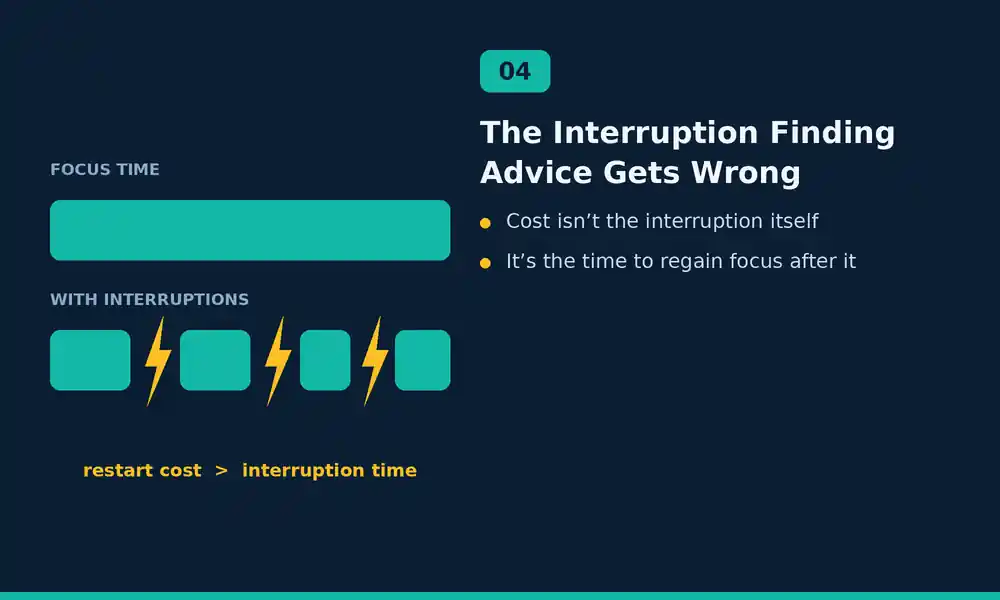
You’ve heard that every interruption costs you about 23 minutes. That number comes from Gloria Mark, a professor at the University of California, Irvine, who studies how people work. In a Gallup Business Journal interview, she explained that interrupted work was typically resumed in 23 minutes and 15 seconds, usually after about two other tasks in between.
The same interview has more detail that gets quoted far less often:
- People in her observations switched activities roughly every 3 minutes and 5 seconds on average.
- Even after removing minor interruptions, they stayed in one “working sphere” for only around 12 minutes and 18 seconds.
- And here’s the surprising bit: not all interruptions are harmful. Mark said an interruption on the same topic as your current task can actually help, because it keeps your thinking on that task. The damaging ones are interruptions about something completely different.
(One note on dates: this research was conducted years ago, so treat the exact numbers as a rough guide, not a law of nature. The pattern it describes has been repeated widely since.)
Why does this matter for choosing tools? Because most founders try to fix interruptions by banning notifications. A smarter business navigation move is to sort them. Questions about the task at hand, asked inside the task, are cheap. Random pings from unrelated channels are expensive.
So when you evaluate a tool, ask whether it keeps conversations attached to the work (comments on a task, notes on a deal) or whether it spreads them across five inboxes. Tools that keep context together reduce the costly kind of interruption.
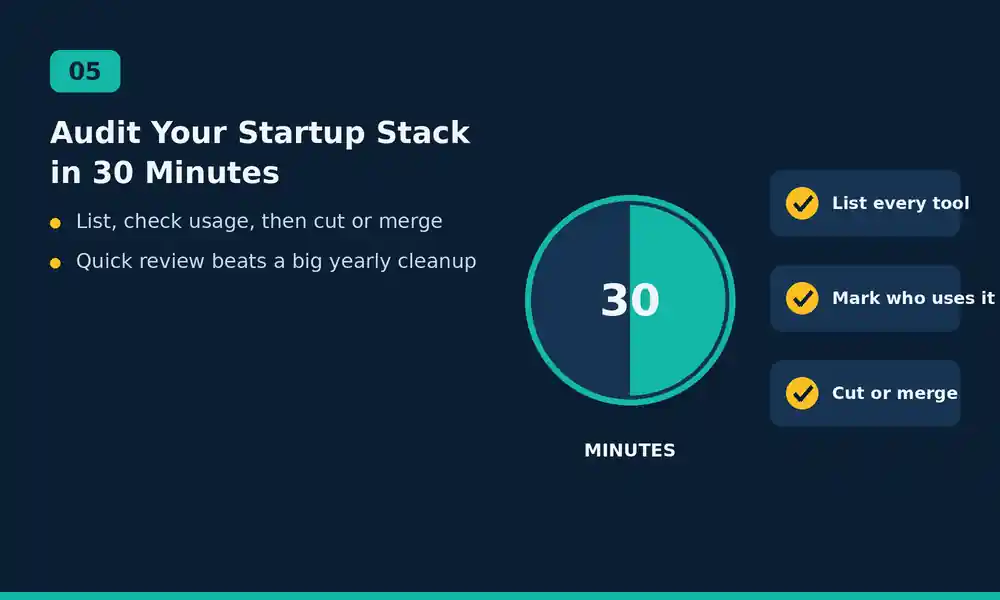
5. How to Audit Your Startup Stack in 30 Minutes
Software sprawl is a quiet drain on small teams, and it’s bigger than most founders assume. Zylo’s 2026 SaaS Management Index found that the average company manages 305 software applications, and that business units now own 81% of SaaS spend while IT directly owns 15% (Zylo). In plain terms, tools are being bought all over the company, often without anyone seeing the full picture.
Gartner has warned that through 2027, organizations without centralized visibility of their SaaS will overspend by at least 25% because of unused and overlapping tools (this warning is cited on Zylo’s cost optimization page).
You may be a ten-person startup rather than an enterprise, but the habit is the same. Here’s a quick audit you can run on a Friday afternoon. Note that this routine is my own practical suggestion, not a finding from the research above.
Step 1: List everything (10 minutes). Open your company card statement and your own subscription emails. Write down every tool, who uses it and what it costs per month.
Step 2: Tag each tool with one verb (5 minutes). For each tool, write the one job it does for you. “Tracks deals.” “Hosts files.” “Schedules posts.” If you need two verbs, it’s probably doing a muddled job.
Step 3: Find the duplicates (5 minutes). Two tools with the same verb? One of them goes.
Step 4: Check last-login dates (5 minutes). If nobody has opened a tool in 30 days, cancel it or downgrade it.
Step 5: Name an owner (5 minutes). Every tool gets one person responsible for it. No owner, no renewal.
For a deeper comparison of what’s worth paying for, see our roundup of Top SaaS Tools for Startups in 2026. It pairs well with this audit, since you’ll know exactly what gaps to fill.
6. The Five Types of Startup Tools That Actually Improve Productivity

Rather than listing brand names that change every year, it’s more useful to think in categories. A lean growth navigate stack usually needs five.
1. A single source of truth for work
This is your task and project system. It should answer “who is doing what by when” without anyone sending a message. If people still ask for status updates, the tool isn’t being used properly, or isn’t the right fit.
2. A customer memory
A simple CRM or even a well-kept shared sheet. It should hold every customer conversation so you can spot the “no market need” signal early. This ties straight back to the CB Insights findings. The faster you hear patterns in customer feedback, the faster you can change course.
3. A numbers dashboard
Cash runway, revenue, churn, acquisition cost. Keep it to five or six numbers. A dashboard with 40 charts is a mood board, not a navigation tool.
4. A communication layer with rules
Chat is fine, but only with clear norms. Which channel is for urgent issues? What’s expected response time? Without rules, chat becomes the unstoppable interruption machine Gloria Mark’s research describes.
5. An automation and AI layer
This is where small teams can punch above their weight. Automating repetitive admin (data entry, report drafts, first-pass research) gives your people back the focused hours that work-about-work steals. If you’re exploring this, Droven.io AI for Business is a good place to see how AI can fit into everyday startup workflows.
A quick rule: if you can’t match a tool to one of these five jobs, ask hard questions before you pay for it.
7. Choosing Where to Sell: Navigation Includes the Marketplace

Productivity isn’t only about internal tools. Where you sell shapes how much effort every sale takes. A marketplace that fits your product can cut your acquisition work dramatically, while a poor fit can eat your margins and your attention.
This is a business navigation decision in the truest sense, since it sets your route to customers. If you’re weighing this right now, our guide on How to Choose the Right Marketplace for Your Business walks through the criteria in detail.
The tool lesson applies here too. Don’t list on five platforms because you can. Pick one, learn it, measure it, then decide whether to expand.
8. Getting Seen: Advertising as a Navigation Signal

Once your operations run smoothly, you need a way to test demand. Paid promotion isn’t just about reach. It’s a fast, cheap way to learn whether people care about your offer, which goes straight at the “no market need” risk.
If you want to put your product in front of the right audience, you can explore Product Advertisement options to run small tests before committing a large budget. Treat the first campaigns as experiments. Set a small budget, define what a good result looks like in advance and review the numbers a week later.
9. A Simple Rule for Adding Any New Tool

Here’s a framework I’d suggest, and I’d call it the “one in, one out” rule with a trial period. It’s a practical habit rather than a researched model, so adapt it freely.
- Name the problem in one sentence. “Our support replies take two days.” Not “we need a helpdesk.”
- Measure the problem today. Write down the current number.
- Trial with one small group for two weeks. Not the whole company.
- Re-measure. Did the number improve? By how much?
- One in, one out. If you keep the new tool, retire an old one that overlaps.
This stops the most common startup mistake: adding tools in response to a feeling rather than a measurement.
10. Common Mistakes That Quietly Kill Productivity

- Buying for the company you hope to be. Enterprise-grade tools for a five-person team add setup work with no payoff yet.
- Letting every team pick its own tools. The Zylo numbers on decentralized buying show how fast this gets out of hand.
- Measuring activity, not outcomes. Tasks completed is not the same as customers served.
- Skipping onboarding. Remember the Asana finding about new hires and duplicated work. A one-page “how we work here” guide pays for itself fast.
- Never cancelling anything. Subscriptions renew silently. Put renewal dates in a shared calendar.
Frequently Asked Questions
Q1. What are growth navigate startup tools?
Q2. How many tools does a startup really need?
Q3. What is business navigation?
Q4. How can I tell whether a tool is improving productivity?
Q5. Do AI tools actually help small teams?
Sources :-
- CB Insights, “Top Reasons Startups Fail”: https://www.cbinsights.com/research/report/startup-failure-reasons-top/
- SmartCompany, summary of CB Insights 2021 figures and Anand Sanwal’s comments: https://www.smartcompany.com.au/startupsmart/analysis/startups-fail-founders-capital/
- Gallup Business Journal, Gloria Mark (UC Irvine) interview on interruptions: https://news.gallup.com/businessjournal/23146/too-many-interruptions-work.aspx
- Asana Anatomy of Work Index 2021 (BusinessWire): https://www.businesswire.com/news/home/20210114005374/en/Asana-Anatomy-of-Work-Index-2021-Work-About-Work-Is-Dominating-in-a-Distributed-World
- Asana Anatomy of Work Index 2022 (investor PDF): https://investors.asana.com/node/6631/pdf
- Asana Anatomy of Work Global Index 2023 (BusinessWire): https://www.businesswire.com/news/home/20230308005268/en
- Asana release coverage on KSL (64% vs 27% finding): https://www.ksl.com/article/news/features/science-and-tech/asana-anatomy-of-work-index-reveals-employees-spend-nearly-two-thirds-of-their-day-on-work-about-work/46657194
- Zylo 2026 SaaS Management Index data: https://zylo.com/blog/how-zylo-automates-software-license-tracking
- Gartner warning as cited by Zylo: https://zylo.com/blog/10-ways-zylo-helps-you-save-money-on-software
[…] App Guide: Email Login & Free Cash Down Growth Navigate Startup Tools to Improve Business Productivity How to Start Freelancing With No Experience: A Practical 30-Day Plan for Beginners Best […]